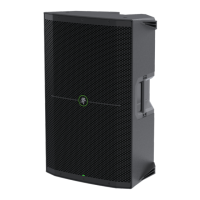
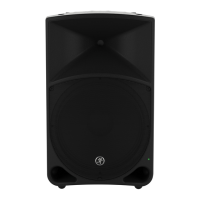
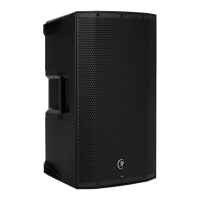
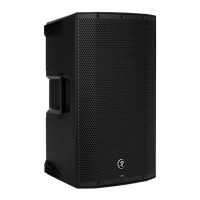
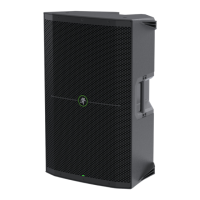
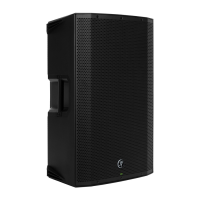
THUMP210XT 10" 1400W ENHANCED COMPACT POWERED LOUDSPEAKER
20
Room Acoustics
ThumpXT loudspeakers are designed to sound fantastic in nearly every application.
But, room acoustics play a crucial role in the overall performance of a sound system.
However, the wide high-frequency dispersion of the ThumpXT loudspeakers helps to minimize the problems that typically arise.
Here are some additional placement tips to help overcome some typical room problems that might arise:
• Placing loudspeakers in the corners of a room increases the low frequency output and can cause the sound
to be muddy and indistinct.
• Placing loudspeakers against a wall increases the low frequency output, though not as much as corner placement.
However, this is a good way to reinforce the low frequencies, if so desired.
• Avoid placing the speakers directly on a hollow stage floor. A hollow stage can resonate at certain frequencies,
causing peaks and dips in the frequency response of the room. It is better to place them on a sturdy stand designed
to handle the weight of the loudspeaker.
• Position the loudspeakers so the high-frequency drivers are two to four feet above ear level for the audience
(making allowances for an audience that may be standing/dancing in the aisles). High frequencies are highly
directional and tend to be absorbed much easier than lower frequencies. By providing direct line-of-sight
from the loudspeakers to the audience, you increase the overall brightness and intelligibility of the sound system.
• Highly reverberant rooms, like many gymnasiums and auditoriums, are a nightmare for sound system intelligibility.
Multiple reflections o the hard walls, ceiling, and floor play havoc with the sound. Depending on the situation,
you may be able to take some steps to minimize the reflections, such as putting carpeting on the floors, closing
draperies to cover large glass windows, or hanging tapestries or other materials on the walls to absorb some of the sound.
However, in most cases, these remedies are not possible or practical. So what do you do? Making the sound system
louder generally doesn’t work because the reflections become louder, too. The best approach is to provide as much
direct sound coverage to the audience as possible. The farther away you are from the speaker, the more prominent
will be the reflected sound.
Use more speakers strategically placed so they are closer to the back of the audience. If the distance between
the front and back speakers is more than about 00 feet, you should use an external delay processor to time-align
the sound. (Since sound travels about foot per millisecond, it takes about /0 of a second to travel 00 feet.)
Keep in mind that the voicing mode is another great way to compensate for some of these issues.
See page for more information.



 To Next Page