around 10 hours. The same battery with a 5-amp load will last
around 2 hours. All of our batteries will come with a milli-amp
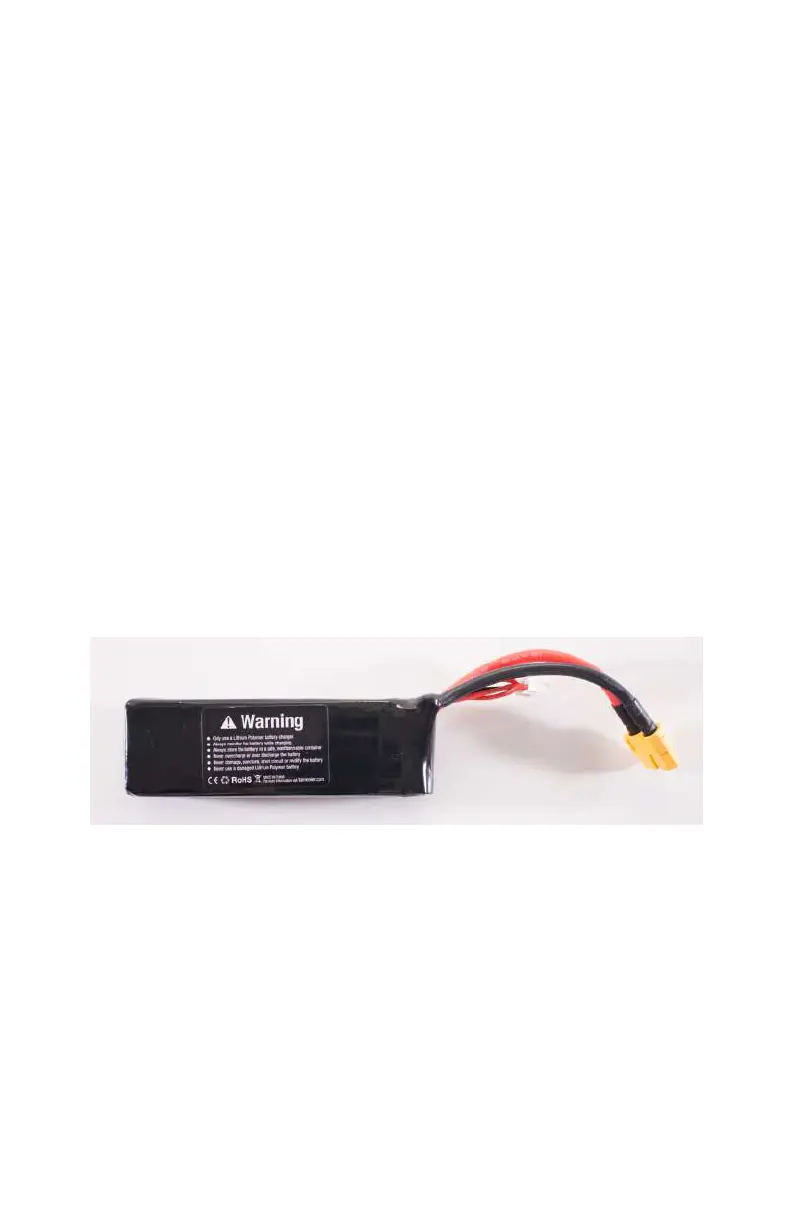
hour (mAh) rating that determines the capacity of our battery
(see Figure 3-6). A battery rated at 2200 mAh has a higher
capacity than one with only 1500 mAh. In theory, this battery
will last more than 30% longer than the 1500 mAh. In the real
world of aviation, though, that might not be the case. A 2200-
mAh battery weighs more than a 1500-mAh battery, which
means it will have to expend more power to lift its quadcopter.
We will discuss this delicate balance more throughout the book.
Although Li-Po batteries helped propel our hobby forward, they
still had some drawbacks. Li-Po batteries become unstable
under certain circumstances and can catch
fire!
For this reason, you should always use great care when handling
Li-Pos. Replace damaged batteries, and never use a battery that
has been punctured in any way; that is a recipe for disaster! Use
fireproof bags when charging Li-Po batteries. Simply hook your
battery up to the charger as you normally would, then place the
battery inside of the fireproof bag and close the opening around
it as much as possible. It is always a good idea to keep an eye on
your batteries while charging.
Figure 3-6. Three-cell 2200-mAh main flight battery.
Leave a little in the tank
The rule of thumb is to never discharge your battery below 3.2
volts per cell. That means that for a three-cell battery, discharg-
ing below 9.6 volts will damage it. We
find that setting an alarm
for 3.5 or 3.4 volts per cell lets us land with just enough in the
tank (about 20%) to keep our batteries happy. Also, avoid stor-
ing batteries that have a full charge. Most decent chargers have
Power Train 51



 To Next Page