Martindale ET4000 / ET4500 Measurements
38
5.3.4 Nulling of test lead resistance
This chapter describes how to null the test lead resistance for the continuity function.
Compensation is required to remove the test lead resistance and the internal
resistances of the instrument from the measured resistance. This lead compensation is
therefore very important in order to obtain correct results. There are two separate
calibration values:
one for r1, rN, r2, R1+R2 and R2,
one for R1+RN, R LOW and CONTINUITY.
The symbol is displayed in the Continuity message fields if the nulling was
successful.
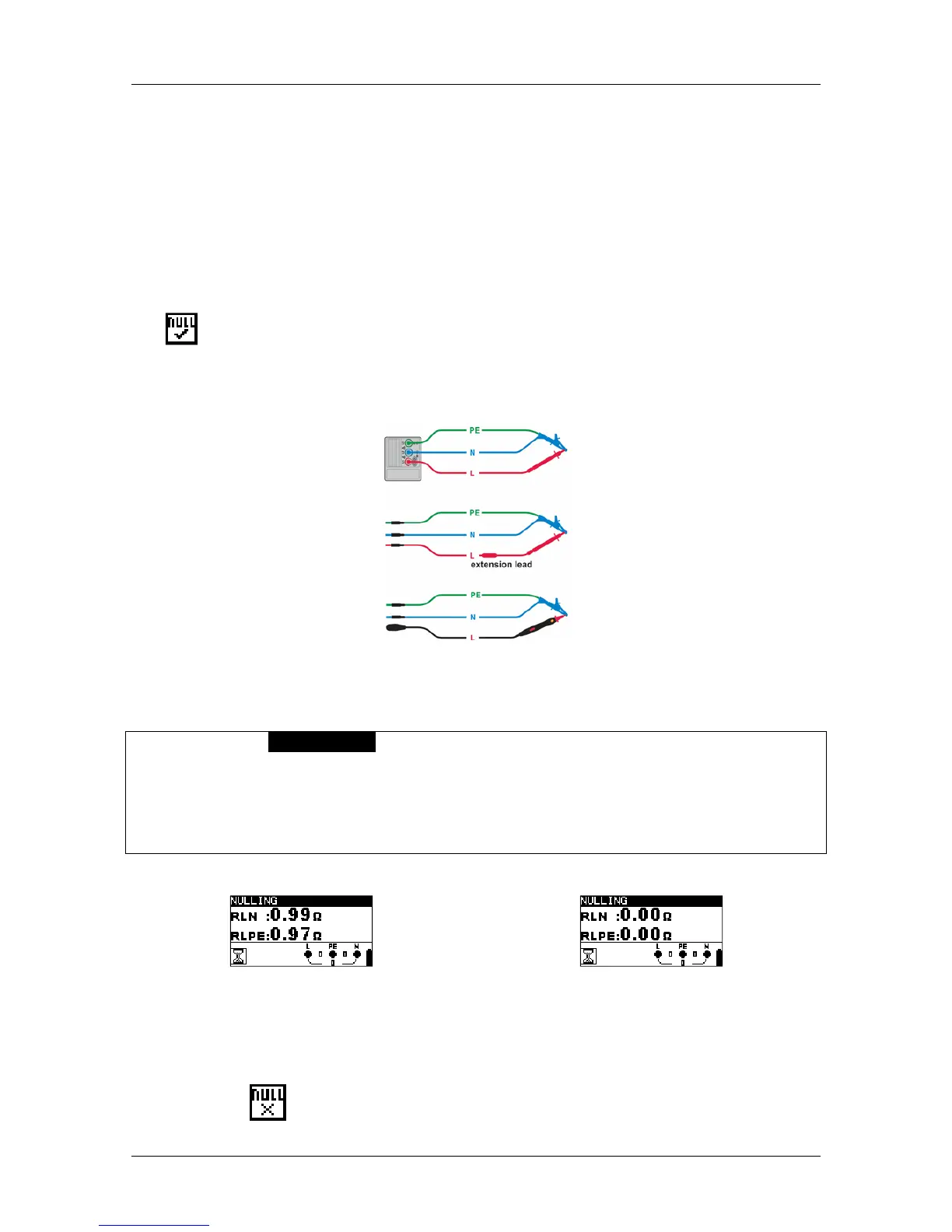
Circuits for compensating the resistance of the test leads
Figure 5.16: Examples of connections for nulling
Nulling of test lead resistance procedure
Select the CONTINUITY function using the function selector switch.
Connect the test leads to the instrument and short the test leads together as
shown (see Figure 5.16: ).
Press the NULL key to perform the test lead nulling.
If the leads were successfully compensated the resistance with the old
compensation data is displayed first and 0.00 Ω afterwards.
Figure 5.17: Results with old (left) and new (right) compensation values
Notes:
The highest value for lead compensation is 5 . If the resistance is higher the
compensation value is set back to the default value.
Symbol is displayed if no compensation value is stored.



 To Next Page