Infrared sensing
Infrared sensors direct infrared light from a transmitter
through the sensing gap to the opposing receiver. In this
arrangement, web lateral position is determined by the
amount of light that arrives at the receiver. Modulation
techniques and infrared filtering is commonly used to
combat interference from ambient light sources.
Correction signal
The sensor information is provided to a signal processor that
can provide many types of signal conditioning, including
amplification, guide point offset compensation, etc. The final
result however, is simply a motor drive signal of the proper
polarity to cause web movement to the desired web position.
Additional provisions are present in the signal processor to
control manual guide positioning, select from multiple sensor
inputs, perform automatic guide centering, and remote control
support.
Web guiding
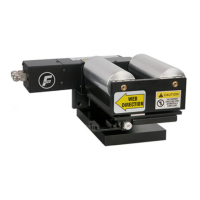
The output of the signal processor is fed to a motor that is
coupled to a set of pivoting rollers. In order to ensure enough
friction exists between the moving web and the guide rollers,
the web path and location of the guide rollers are designed to
ensure a certain amount of surface area contact with the roller
surface. Under these conditions, the pivoting roller set in
combination with web movement over the rollers, provides the
forces needed to control lateral web displacement.
As a system, these concepts work together to sense the
web lateral position and generate a motor drive signal of
proper polarity to cause the web to move toward the
desired location. This cycle is repeated continuously thus
forming a closed loop control system to actively maintain
the web at the desired position.


 To Next Page