1. Introduction
All of the information herein is the exclusive proprietary
property of Maxcess International, and is disclosed with the
understanding that it will be retained in confidence and will
neither be duplicated nor copied in whole or in part nor be
used for any purpose other than for which disclosed.
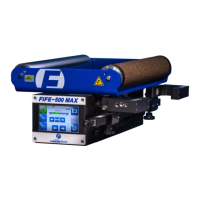
The FIFE-500 MAX Web Guiding System is designed for use
in industrial equipment that is involved with processing a
moving web. It is typically installed in line with web travel to
provide lateral steering of the web in critical areas such as
winding, rewinding, or any important mid-stream process.
It is not uncommon to find multiple web guides steering the
same web at different locations of web travel. Guiding a web
is accomplished by applying several concepts with each
directed at a particular part of the task. The basic concepts
are:
Sense the lateral position of the web edge (sensors)
Generate a correction signal proportional to the error
(signal processor)
Apply forces to the web to non-destructively move it to
the desired location (motor-controlled mechanical
pivoting rollers)
Sensing
Sensing the lateral position of the web edge can be done by
a variety of sensing technologies with the most common
being infrared or ultrasonic. The sensing technology
employed in any given application is driven by the
respective web properties in combination with the amount
sensor proportional band that is needed. For optically
opaque webs, infrared sensors are common, but for webs
that are highly transparent, ultrasonic methods are more
successful.


 To Next Page