75
Appendix A – Test types explained
Each test group is constructed from a series of individual tests. The tests are selected depending on the electrical construction of the asset
under test. The operator must understand the type of electrical construction of the asset before a correct selection of tests can be made.
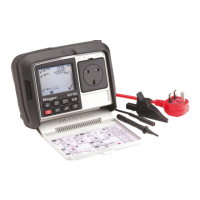
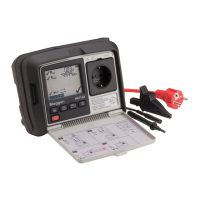
The tests available on the PAT400’s are as follows:
A.1 Continuity & bond testing
Continuity and bond testing are both used to confirm the existence of a safety earth return path of a Class I asset. However they differ in
how they work and both have their benefits and drawbacks.
(i) Continuity (low current or “Soft”) testing
This test uses a 200 mA test current at 4 to 5 Vdc. The test current is low so that there is no risk of damaging earth connections that may
only exist for functional, rather than safety reasons.
(ii) High current (Bond) testing (not available on the PAT410)
Uses a 10 A or a 25 A AC test current at 8-9 V.
This test is used where concerns that an earth may be maintained by a few strands of wire or where poor surface contact by the probes
or clips could give a misleading reading.
This test is frequently the preferred test by many organisations.
(iii) In situ bond testing (200mA)
In situ bond testing is the ability to measure the earth integrity of a class I asset that is “hard wired” to the electrical supply. Normally
there would be no convenient method to connect the asset to the PAT400 without disconnecting the equipment from the supply.
The PAT400 can be connected to an adjacent electrical outlet and a bond test conducted to the case of the asset. The measured
resistance will be:
The resistance of the asset to the earth circuit (wall plate or fused spur)
The resistance of the fixed wiring through the building to the earth point into which the PAT400 is connected. This could be a few metres
or 10’s of meters.
Allowance should be made for the additional building (fixed) wiring resistance when deciding if the asset is safe to use.
(iv) Parallel earth paths
Parallel earth paths warnings apply to a range of measurements. See Appendix A.8 for further information.
(v) 25A Bond limit exceeded
Testing a very low resistance circuit using the 25A Bond test can generate the message:
25A Bond limit exceeded,
10A Bond enabled.
To prevent the high current bond test from exceeding the 25 A limit, testing of very low resistance
(typically <0.03 Ω) will automatically drop the test current to 10 A.
(vi) Excessive lead resistance



 To Next Page