Need help?
Do you have a question about the Memmert ICP and is the answer not in the manual?
Explains the manual's purpose, target audience, and importance of safety instructions.
Details appliance variations, firmware relevance, and lists supplementary documents.
Provides guidance on keeping the manual accessible and transferring it with the unit.
Explains warning terms (DANGER, WARNING, CAUTION, NOTICE) and safety symbols.
Covers inherent risks, safety compliance, and potential hazards of the appliance.
Outlines personnel qualifications, responsibilities, and owner duties for safe operation.
Specifies correct applications and warns against misuse, highlighting risks like explosion.
Prohibits modifications and advises immediate action for malfunctions.
Provides step-by-step instructions for safely switching off the unit in an emergency.
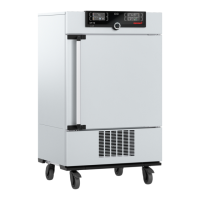
Illustrates and labels the main physical components and features of the appliance.
Explains the heating capabilities up to 60°C and cooling down to -12°C.
Details materials, electrical data, protection class, interference suppression, and fuses.
Specifies requirements for electrical connection and mentions communication interfaces.
Describes using Ethernet and USB for program transfer, data export, and software management.
Details the information presented on the appliance's nameplate for identification.
Presents detailed specifications for appliance size, materials, electrical data, and packaging.
Lists relevant EU directives and standards, including EMC and machinery directives.
Specifies the required operating ambient temperature, humidity, and installation altitude.
Lists standard included items and optional accessories for the appliance.
Highlights critical safety precautions for lifting, transport, and setting up the heavy appliance.
Covers delivery, transport methods, and unpacking procedures with checks.
Advises on storage conditions and initial setup, including tipping warnings.
Lists site requirements, clearances, and instructions for installing the anti-tilt bracket.
Guides on how to adjust the appliance doors for proper alignment and closure.
Covers first-time operation, acclimatization, power connection, and initial switch-on.
Defines personnel qualifications and safe procedures for opening the appliance door.
Provides instructions on loading items, warning about hazardous vapors and chemical compatibility.
Introduces the main control interface for setting parameters and monitoring appliance status.
Guides on fundamental interaction with the ControlCOCKPIT for parameter adjustment.
Introduces Manual, Timer, Programme, and Remote control modes.
Details continuous Manual operation and remote control functionality.
Guides on setting and using the timer function for specific operational durations.
Details starting and managing programs created using external software.
Covers starting active programs and procedures for cancelling them.
Introduces the overtemperature protection features and alarm indications.
Introduces the overtemperature protection features and alarm indications.
Details electronic, automatic, and mechanical temperature monitoring systems.
Guides on setting alarm limits, tolerance bands, and enabling ASF.
Explains how to view and analyze temperature data graphically.
Explains how to view and analyze temperature data graphically.
Provides steps for safely powering down the appliance.
Lists specific temperature alarms, their causes (e.g., ASF, TWW), and corrective actions.
Lists specific temperature alarms, their causes (e.g., ASF, TWW), and corrective actions.
Addresses appliance heating failures and cooling problems, suggesting troubleshooting steps.
Lists common error messages, their causes, and recommended rectifying actions.
Explains error E-3, startup animation issues, and appliance behavior during power failures.
Introduces the Menu mode interface and demonstrates general setting procedures.
Lists adjustable parameters in Setup, including network, unit, timer, and defrost settings.
Lists adjustable parameters in Setup, including network, unit, timer, and defrost settings.
Guides on configuring the appliance's IP address and subnet mask for network connectivity.
Explains selecting temperature units (°C/°F) and configuring timer mode behavior.
Guides on choosing shelf type (grid/metal) for optimal performance.
Details automatic defrost settings and remote control configuration.
Explains how to set up the gateway for connecting different networks.
Provides instructions for setting the appliance's date, time, time zone, and daylight saving.
Details the procedure for calibrating temperature at three points using a reference instrument.
Explains transferring, selecting, and deleting programs from USB storage.
Guides on configuring audible alerts for various events like key presses or alarms.
Explains the continuous data logging and how to export log files.
Introduces the USER ID feature for parameter locking and access control.
Introduces the USER ID feature for parameter locking and access control.
Details the process of activating and deactivating the USER ID using a USB storage medium.
Provides instructions for cleaning interior surfaces, plastic parts, glass, and the cooling unit.
Recommends annual calibration and outlines policy for repairs by qualified personnel.
Specifies unit storage conditions and explains disposal regulations (WEEE) and safety measures.
 General
| Brand | Memmert |
|---|---|
| Model | ICP |
| Category | Climate chamber |
| Language | English |

 To Next Page