NB: If a frequency list has been uploaded from a compatible EFIS or GPS
and activated by menu function (in the First Level Menu), only 20 channels
will be available. The list size is determined by the SL30 and SL40
communications protocol and may have from 1 up to a maximum of 20
entries.
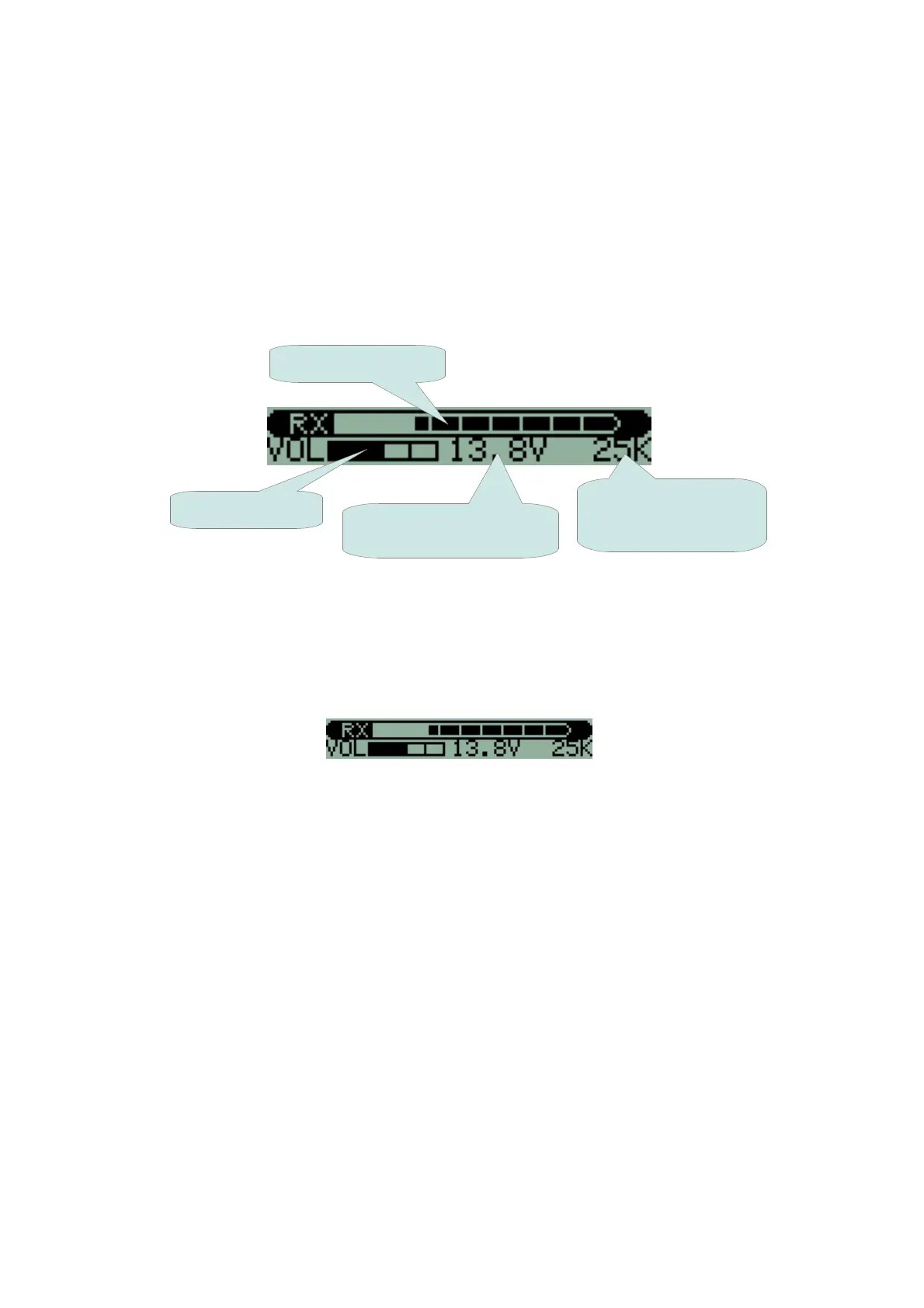
The STATUS display
The STATUS display provides an Rx/Tx bargraph, and annunciators for
volume level, supply voltage or transmitter temperature and frequency
spacing.
RX/TX bargraph
The V6 Transceiver display includes a bargraph showing the strength of a
received signal during RX or modulation level of the transmitter during TX.
Due to good receiver sensitivity, signals of medium strength will fill the
bargraph.
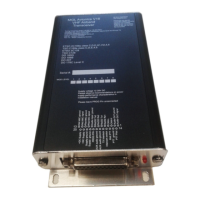
Receiving transmission of moderate strength
During TX the bargraph shows modulation of the actual transmit carrier. This
is a visual form of side tone making it possible to judge how well the signal
from the microphone is modulating the transmitter. Note that this bargraph
does not show the level from the microphone – this shows directly the
modulation of the signal being transmitted.
Good modulation will cause the bargraph to just touch the right hand side of
the display for the loudest parts of transmission. Often this is achieved with
click “T” or “SHH” sounds. Average level of speech during transmission
should be between 50% and 75% on the bargraph.
The modulator for V6 transmitter is under direct microprocessor control. The
audio signal to be transmitted is processed using digital signal processing
algorithms before being sent to the modulator.
Software control of the modulator allows precise control of modulation under
varying power supply and temperature conditions. It also allows wide range
control of the audio signal amplitude at the modulator. This prevents over-
modulation while still allowing deep and rich modulation of the carrier. This
9
Rx/Tx bargraph
Volume level
Supply voltage (or
transmitter temperature)
Frequency spacing
25KHz/8.33KHz or
CHANNEL memory


 To Next Page