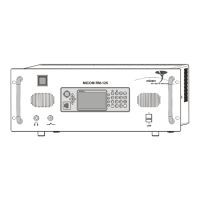
Introduction
3
Power Source
The radio is designed for 13.8 V ±20% negative-ground operation and may be connected to a
standard 12 V battery.
CW Keying Operation
When the CW key is pressed, the radio transmits a continuous wave (at the full programmed power)
and stops transmission when the key is released. CW keying operation is enabled by connecting a
Morse key to the accessories connector. If you wish to operate CW keying with external headphones,
the S809 Interface cable can be used, thus enabling a standard PL55 headphone and standard PL99
Morse key to be connected to the accessories connector.
Programmable Features
The radio can be programmed using a PC running the MICOM Radio Control Application (MRC) or
the Radio Service Software (RSS). The following radio features can be programmed:
• Up to 200 simplex/half duplex channels supporting SSB (J3E), AME (H3E), or Pilot (R3E) modes.
• Up to four levels of output power (up to 125W PEP and average).
• Five scanning groups of up to 200 channels, each with guard channel.
For further details, refer to “MICOM Radio Control Application Owner’s Guide”, Publication
6886869J01, or to “MICOM-3 HF-SSB Transceiver, RSS User’s Guide”, Publication 6886867J01.
MICOM-3 Options and Accessories
• RS-232 remote control interface
• Linear power amplifier interface
• Phone patch interface
• Data/fax modem interface
• MRC or RSS for PC
• High (0.1 ppm) frequency accuracy
• micomLink
• VP-116 voice privacy unit
• HF vocoder unit
• Internal GPS receiver
• ISB operation
• Desktop microphone
• Automatic antenna tuners
• Continuous duty data transmission kit
• AC power supply
• 500 W linear power amplifier
• 1 kW linear power amplifier
• Antennas and grounding
• CW key and headphones
• External speaker.


 To Next Page