Chapter Five: Operation How To Confi
ure the Tri
Points
75
How To Configure the Trip Points
The 670 instrument has two trip points, and each trip point controls a relay. The relays provide
24 Volts AC/DC @1 Amp resistive (contact rating) power. You assign a channel number, an
initial state, and high and low values for each trip point. Refer to
The [TRIP POINTS] Key,
page 54, for a complete description of trip points.
1. Connect the trip point relays, on the I/O connector, to your system.
Table 9, page 37, lists the complete pinout for the I/O connector.
2. Press the [
TRIP POINTS
] key on the front panel of the 670 instrument.
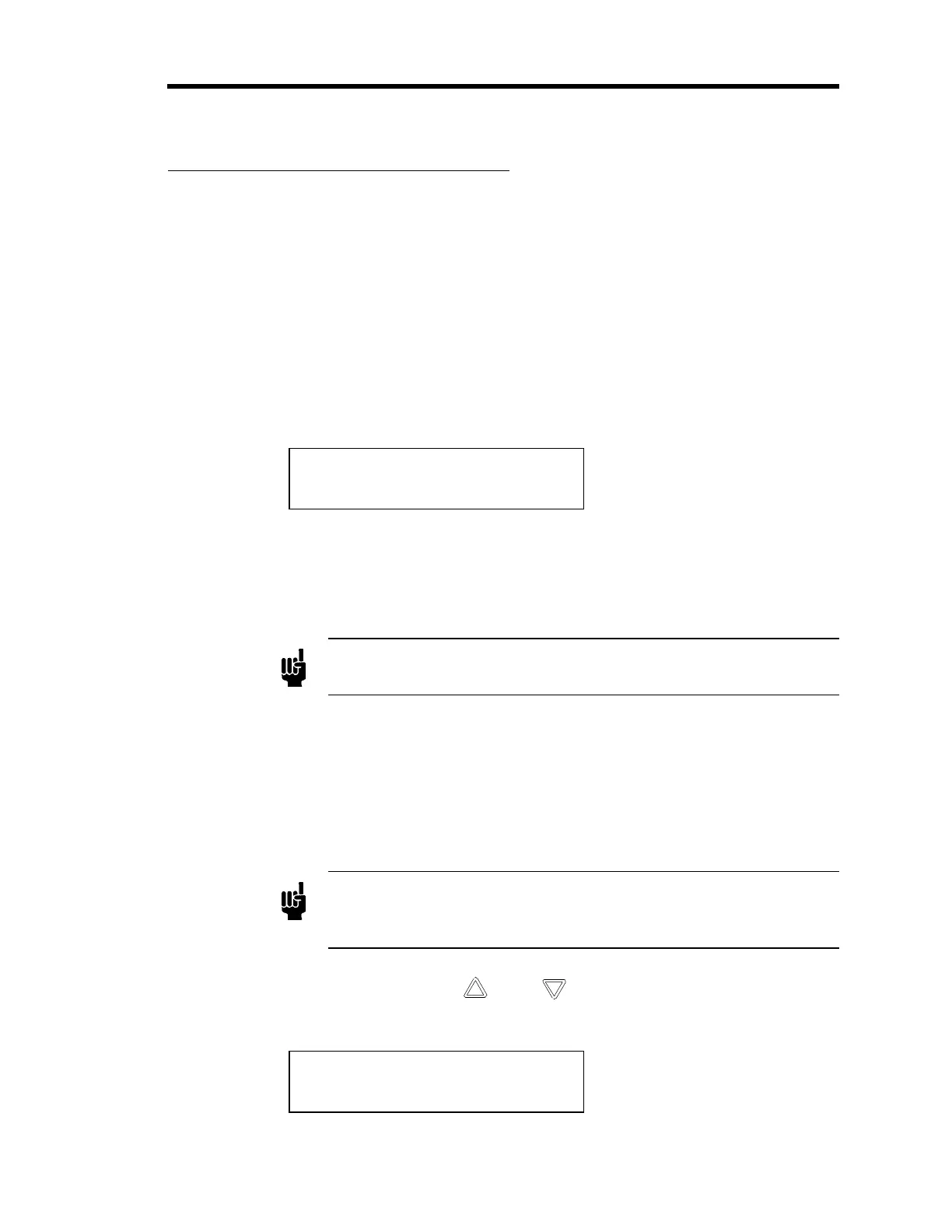
The system responds by displaying the screen below.
TP A HIGH
7.80000E+2 Torr
3. Use the [
CURSOR
] key and the Adjust knob to set the value for the TP A HIGH entry.
The entry can vary from
±
105% of full scale. The actual signal output depends on the
range selection.
Note
A +105% of full scale setting for the high entry or a -105% of full scale
setting for a low entry,
disables
the trip point.
4. Press an arrow key to move the cursor the to TP B entry.
The system responds by displaying the value of the TP A LOW entry.
5. Use the [
CURSOR
] key and the Adjust knob to set the value for the TP B HIGH entry.
Refer to step 3 above for an explanation of the setting.
Note
Switching the range may delay the response of the trip points to a change
in pressure. Immediately after the range changes, the 670 unit waits until
a stable pressure reading is achieved before activating the trip point.
6. Repeatedly press an arrow key ( [ ] or
[ ] ) to display the relay state screen.
The system responds by displaying the relay state screen.
TP A ENERGIZED
TP B ENERGIZED
Artisan Technology Group - Quality Instrumentation ... Guaranteed | (888) 88-SOURCE | www.artisantg.com


 To Next Page