1 Safety Regulations
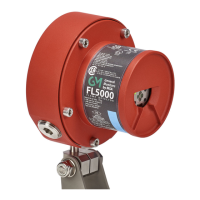
US FL5000 Multi-Spectrum Flame Detector 5
• The internal terminals are suitable for connection of a wire equal to or greater than the power input wiring and at a
minimum of 1 mm
2
conductor.
• An End-Of-Line (EOL) resistor with a maximum power dissipation of up to 0.6 W may be fitted in the circuit inside the
enclosure.
• The device may only be powered by a power supply unit with a limited energy electric output in accordance with
CAN/CSA-C22.2 No. 61010-1-12 / UL Std. No. 61010-1 (3rd Edition) chapter 6.3.1/6.3.2 and 9.4 or class 2 according
to CSA 223/UL 1310.
• The FL5000 contains components that can be damaged by static electricity. In order to avoid static electricity, special
care must be taken when wiring the system to ensure that only the connection points are touched.
OPERATION
• Do not install or operate a device that is damaged.
• Install the device in a location away from conditions (such as high-pressure steam) where electrostatic charge can
collect on nonconducting surfaces. This equipment uses an external nonmetallic coating. If extreme levels of
electrostatic charge collect, ignition can occur.
• Make sure that there is no physical blockage from permanent objects such as structures and equipment or temporary
objects such as personnel and vehicles in the sensor's field of view. If there is physical blockage in the sensor's field
of view, the device cannot accurately monitor the area for flame.
• Make sure that there is no ice, dirt, or debris on the optical window. Blockage of the optical window can result in a
Fault condition.
• Keep the device safe from vibration and mechanical shock, which can cause damage.
• Do NOT connect or disconnect equipment when power is supplied to the device. Doing so can result in serious
damage to the equipment. The warranty does not apply to equipment that is damaged in this way.
• The device has components that can be damaged by electrostatic discharge (ESD). When you do work with the
device wiring, be careful to touch only the connection points. The warranty does not supply coverage for components
that are damaged by ESD.
• The CSA Mark applies to process control functions only.
• Through engineering design, testing, manufacturing techniques, and rigid quality control, MSA supplies the finest
flame detection systems available. The user must recognize his responsibility for maintaining the flame detection
system in operational condition.
• Silicone Room Temperature Vulcanization (RTV) is not an approved moisture barrier. If used, damage to internal
components will arise.
• Damage to the FL5000 housing where any internal components or protective seals are broken, compromises the
safety and usability of the device. An FL5000 with a damaged or open housing should not be used in a hazardous
environment. Such damage includes fractures in the housing, cracks in any internal components, or cracks in the
protective seals.
RADIO INFORMATION
Bluetooth
• This product incorporates Bluetooth
®
wireless technology. The Bluetooth word mark and logos are registered
trademarks owned by Bluetooth SIG, Inc., and any use of such marks by MSA is under license. Other trademarks
and trade names are those of their respective owners.
• The RF radiation power used to activate the RFID tag antenna shall not exceed 6 Watts for EPL Group I applications
or 2 Watts for EPL Group IIC applications.
FCC and ISED Notice for US and Canada
This equipment has been tested and found to comply with the limits for a Class B digital device, pursuant to part 15 of the
FCC Rules. These limits are designed to provide reasonable protection against harmful interference in a residential
installation. This equipment generates, uses and can radiate radio frequency energy and, if not installed and used in
accordance with the instructions, may cause harmful interference to radio communications.



 To Next Page