4 Principles of Operation
US FL5000 Multi-Spectrum Flame Detector 13
4 Principles of Operation
The FL5000 is a discriminating Multi-Spectrum Flame Detector, which makes use of infrared sensors for different IR
wavelengths and characteristics. This combination provides a flame detection system, which is highly immune to false
alarms.
The advanced flame detection algorithm classifies the output signals from the detector as either fire or no-fire. The unit
then produces the following output signals:
• 0 to 20 mA signal (3.5 or 1.25 to 20 mA with optional HARTprotocol)
• INSTANT ALARM relay contact
• SUSTAINED ALARM relay contact
• FAULT relay contact
• RS-485 Modbus output
NOTE: Refer to 5 Installation for more information on detector outputs.
NOTE: FL5000 device firmware version is available for viewing via HART Communications, Flame Connect App, or
FL5000 Tunes.
4.1 LEDOperation Mode Definitions
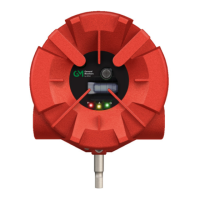
Four light emitting diodes (LEDs) are visible on the front detector window. These LEDs provide a visual indication that
corresponds with the detector’s outputs. The following LED flashing sequences indicate various operating conditions:
Device Status Standard Mode
No Power ALLLEDs OFF
Power up ALL LEDs Blink alternately for 15 seconds
Ready
Green LED ON with heartbeat (5s ON, 0.5s OFF)
Yellow LED OFF
RedLED OFF
Blue LED OFF
Instant Alarm
Green LED OFF
Yellow LED OFF
RedLED Blinking slowly (1 Hz)
Blue LED OFF
Sustained Alarm
Green LED OFF
Yellow LED OFF
RedLED ON
Blue LED OFF
COPM Fault
Green LED OFF
Yellow LED Blinking slowly (1 Hz)
RedLED OFF
Blue LED OFF













 To Next Page