4 Principles of Operation
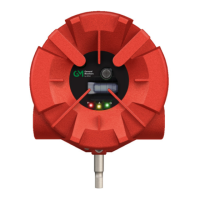
US FL5000 Multi-Spectrum Flame Detector 15
4.3 Test Mode Initiation
NOTE: The FL5000 will not detect a flame while in Test Mode.
The FL5000 has the ability to initiate a special Test Mode, which enables the user to test the response of the unit without
the use of a flame source. Once the Test Mode has been activated it responds to the Test Lamp as a simulated flame
source.
There are four options for enabling Test Mode on the FL5000:
1. Flashing the Test Lamp (4.3.1 Test Lamp)
2. HART command (4.3.2 HART Command)
3. Modbus command (4.3.3 Modbus Command or Grounding Test Wire )
4. Grounding the test wire (4.3.3 Modbus Command or Grounding Test Wire )
Each time the Test Mode is activated and the Test Lamp is successfully detected, regardless of which option is used, the
FL5000 maintains a timestamp of the test. This timestamp is available to the user via Modbus registers 0x30 to 0x3A. For
Modbus register information, please refer to the Modbus manual maintenance event log.
4.3.1 Test Lamp
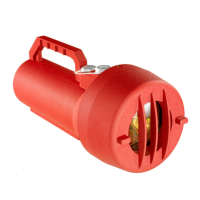
The Test Lamp is a battery operated, rechargeable, test source specifically designed to test General Monitors’ IR Flame
Detection Systems. It consists of a high-energy broadband radiation source that emits sufficient energy in the infrared
spectra to activate the IR detector. To simulate a fire, the TL105 Test Lamp automatically flashes a signal that the FL5000
recognizes. The lamp must be set to rotary switch position “4” to be recognized by the FL5000.
Operating Instructions
• The FL5000 has the ability to be put into a special test mode activated state by momentarily grounding the test mode
pin on the unit or by issuing a Modbus write command to register 0x4A.
• The unit will respond by going into this test mode activated state and by blinking a unique flashing pattern with the
green LED on for 0.9 seconds and off for 0.1 seconds. The analog current output will respond by outputting 1.5 mA
(3.5 mA with HART and small HART current disabled).
• While the FL5000 is activated in test mode via the Test Lamp, the FL5000 will detect the TL105 Test Lamp as a flame
source.
○ The analog output and relays will respond as if a flame were present.
○ The analog output will rise from 1.5 mA (3.5 mA with HART and small HART current disabled) to 16 mA
(warning condition) and then to 20 mA (alarm).
○ Relays will trip.
○ In addition, an alternating red/green LED blink pattern is displayed.
• By momentarily grounding the test mode pin a second time, or by re-issuing a Modbus write command to register
0x4A, or after a 3-minute time out, the unit will return to normal operation in the Ready state.
• The TL105 Test Lamp triggers the FL5000 into test mode, causing an alarm condition.
It is important to begin a series of flame detector checks with a fully charged Test Lamp. Stand between 10 and 35 feet
from the FL5000 that is to be tested and aim the Test Lamp directly into the detector window. Press the ON button and be
sure the high intensity pulsing beam strikes the detector face squarely. Hold the Test Lamp as steady as possible.
To conserve charge, do not operate the Test Lamp longer than is necessary to test each channel.
When the battery level drops below the level required to maintain the proper intensity of the lamp, an internal low voltage
circuit will shut the lamp off until the battery has been recharged. Please refer to the TL105 Test Lamp manual for complete
operating instructions.





 To Next Page