GENERATOR SERVICE AND TROUBLESHOOTING MANUAL — REV. #0 (08/29/23) — PAGE 21
WIRE INSULATION
All generator windings, motors, and extension cords have
electric wire that is covered with some form of insulation.
Electrical wire is normally copper and is a good conductor
of electric current that powers various electric devices.
The insulation material (ber) must be the opposite of the
conductor material; it should resist the current and keep it
in its path along the conductor.
The purpose of the insulation around a conductor is similar
to that of a pipe carrying water. Pressure on water from
a pump causes water to ow along the pipe. If the pipe
were to spring a leak you’d waste water and lose some
water pressure. With electricity, voltage is like the pump
pressure causing current to move along the copper wire.
As with the ow of water in a pipe, there is resistance to
the ow of current but it is much less along the conductor
than through its insulation.
Wire insulation is hardened over time due to heat
exposure and overheating. Long-term heating should be
more uniform. A short, excessive heat cycle may have
less hardening and burning on the outer perimeter and
excessive heat signs toward the center or heat source.
Worn wire insulation allows wires to short. Wire insulation
deteriorates from physical contact when wires rub together
due to vibrations. Eventually, the internal wires can short
to each other or to ground.
It should be noted that no insulation is perfect, meaning
no insulation has innite resistance, so some electricity
does ow along the insulation or even through it to ground.
The current passing through the insulation may only be a
millionth of an ampere (one microampere) but it is the basis
of insulation testing. A higher voltage tends to cause more
current leakage through the insulation. This current leakage
can become a problem if the insulation has deteriorated.
All of this leads us to determine “what is good insulation.”
Under normal conditions, “good” means a relatively high
resistance to current. Or it can also be stated that a good
insulation has the ability to keep a high resistance. A
suitable way of measuring resistance can tell us how good
the insulation is. Also if regular insulation measurements
are made you can track trends towards its deterioration.
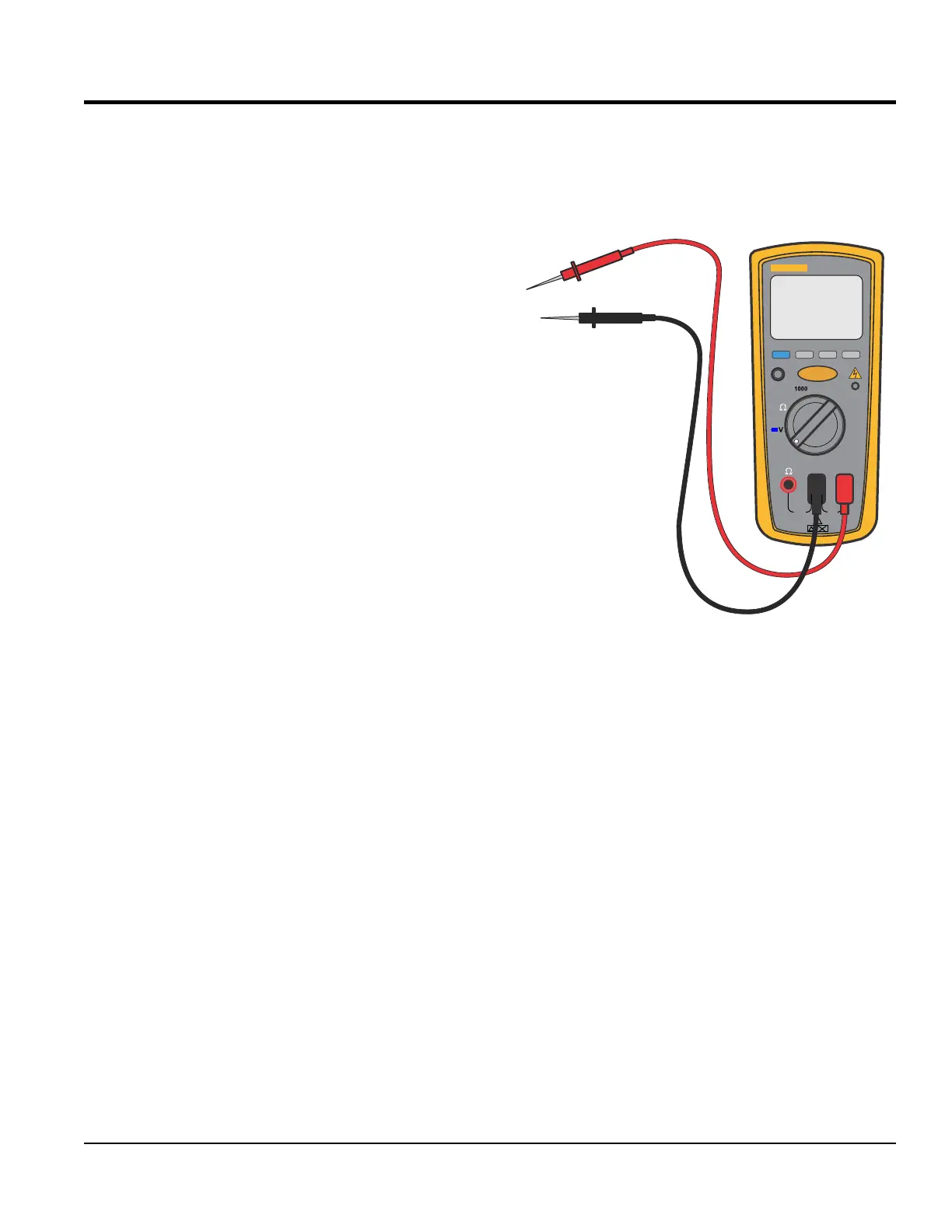
Megohmmeters (Figure 14) provide a quick and easy
way to determine the condition of the insulation on wires,
generators, and motor windings. A megohmmeter is an
electric meter that measures very high resistance values by
sending a high-voltage signal into the object being tested.
Figure 14. Megohmmeter
TEST
FLUKE
OFF
V
500
V
250
V
100
V
50
V
LOCK
COMPARE
PI/DAR
ZER0
+
1507
INSULATION TESTER
FUSED
COM
INSULATION
V
600V
CAT IV
!
!
>
660V
ELECTRICAL INSPECTION





 To Next Page