PAGE 44 — GENERATOR SERVICE AND TROUBLESHOOTING MANUAL — REV. #0 (08/29/23)
ROTATING RECTIFIER TEST
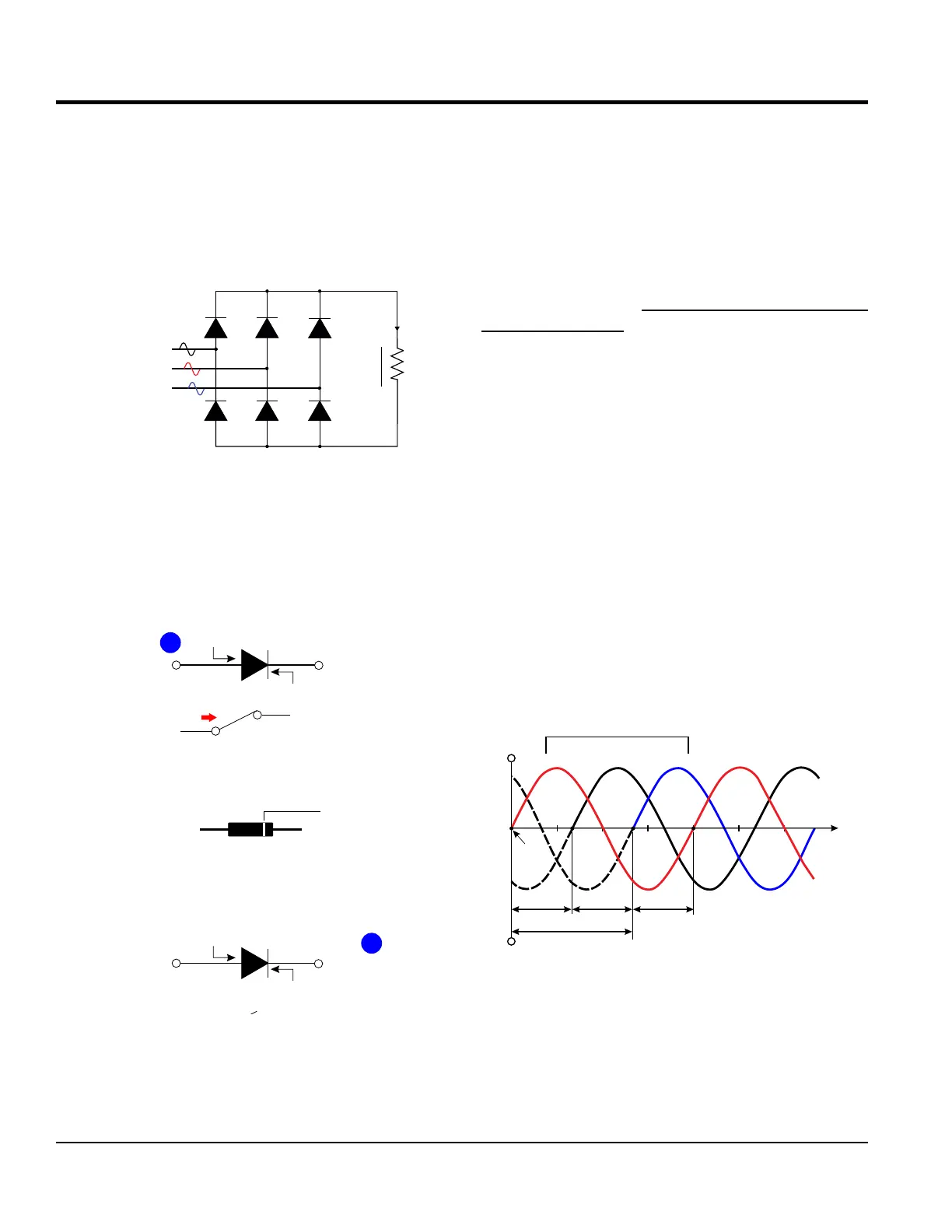
3-PHASE RECTIFICATION
3-phase rectification is the process of converting a
balanced 3-phase power supply into a xed DC supply
using solid-state diodes. The rotating rectier is a full-wave
bridge rectier and utilizes six diodes (Figure 45) to convert
one full wave of alternating current into one full pulse of
direct current.
Figure 45. 3Ø Rectication
A diode is a semiconductor device that essentially acts
as a one-way switch for current. It allows current to ow
easily in one direction (Figure 46A), but restricts current
from owing in the opposite direction (Figure 46B).
Figure 46. Forward/Reverse Bias Diode
D
1
D
2
D
4
D
3
D
5
D
6
I
DC
R
LOAD
V
DC
U
V
W
+
-
3-PHASE, 3 WIRE
AC SUPPLY
ANODE (+)
CATHODE (-)
POLARITY (+)
CURRENT FLOW (YES)
FORWARD BIAS
NEGATIVE
LEAD
ANODE (+)
CATHODE (-)
REVERSE BIAS
POLARITY (+)
ANODE (+)
ACTUAL DIODE
STRIPE
INDICATES
CATHODE (-)
NEGATIVE
LEAD
A
B
Single-phase generators are generally 120
VRMS
(root mean
square voltage) or 240
VRMS
phase-to-neutral, also called
line-to-neutral (L-N), and nominally of a xed voltage and
frequency producing an alternating voltage or current in the
form of a sinusoidal waveform being given the abbreviation
of “AC”.
Three-phase rectification, also known as poly-phase
rectication, is similar to single-phase rectication. The
main difference is that three single-phase circuits are
connected together to produced a three-phase output.
The advantage is that 3-phase rectication circuits can
be used to power many data centers, commercial and
industrial applications such as motor control or battery
charging systems which require higher power requirements
than a single-phase rectier circuit is able to supply.
3-phase generators combine together three AC voltages
of identical frequency and amplitude, with each AC voltage
being called a “phase”. These three phases are 120
electrical degrees out-of-phase from each other producing
a phase sequence, or phase rotation of: 360 ÷ 3 = 120 as
shown in Figure 47.
Three-phase alternating current (AC) can be used to
provide electrical power directly to balanced loads and
rectiers. Since a 3-phase AC supply has a xed voltage
and frequency, it can be used by a rectication circuit to
produce a xed DC voltage.
Figure 47. 3-Phase Waveform
240°
120°
120°
120°
270°90°
180°
360°
0°
0
TIME
-V
+V
A B C
PHASE





 To Next Page