GENERATOR SERVICE AND TROUBLESHOOTING MANUAL — REV. #0 (08/29/23) — PAGE 51
ECU 9988N
ENGINE CONTROL UNIT (ECU 9988N)
The ECU 9988N is an auto-start/stop engine controller.
This controller should not be confused with the actual
engine manufacturer’s Engine Control Module (ECM).
The ECM monitors engine operational inputs and directly
controls outputs for fuel delivery actuators, electronic fuel
injectors, etc. While the ECM does include safety
shutdowns, its main purpose is regulating fuel to meet
emission standards. The ECM is preprogrammed with
proprietary information by the engine manufacturer.
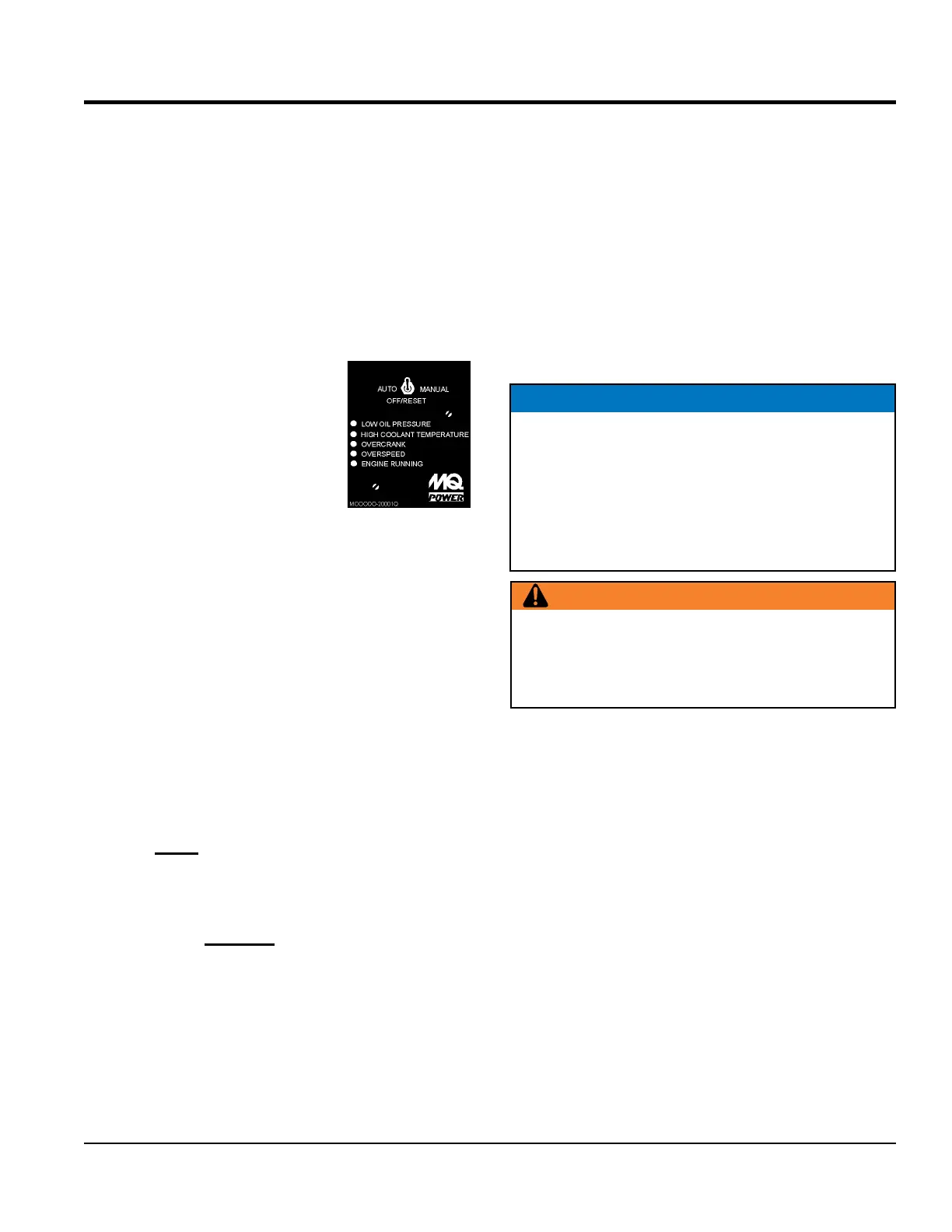
The ECU controller has a vertical row
of status LEDs (inset), that when lit,
indicate that an engine malfunction
(fault) has been detected. When a
fault has been detected, the engine
controller (ECM) will evaluate the fault
and all major faults will shut down the
generator.
During cranking cycle, the ECU will attempt to crank the
engine for 10 seconds before disengaging.
If the engine does not engage (start) by the third attempt,
the engine will be shut down by the engine controller’s
Over Crank Protection mode. If the engine engages at a
speed (RPM) that is not safe, the controller will shut down
the engine by initializing the Over Speed Protection mode.
Also the ECM will shut down the engine in the event of
low oil pressure, high coolant temperature and loss of
magnetic pickup. These conditions can be observed by
monitoring the LED status indicators on the front of the
ECU controller module.
Low Oil Pressure — Indicates the engine oil pressure
has fallen below a predetermined level. The oil pressure
is detected using variable resistive values from the oil
pressure sending unit. This is considered a major fault.
High Coolant Temperature — Indicates the engine
temperature has exceeded a predetermined level. The
engine temperature is detected using variable resistive
values from the temperature sending unit. This is
considered a major fault.
Overspeed Shutdown — Indicates the engine is running
at an unsafe speed. This is considered a major fault.
Overcrank — Indicates no engine start after 3 attempts
The ECU has a 3-position switch located at the top of
the unit. This switch controls the running of the unit. If this
switch is set to the OFF/RESET position, the unit will not
start. When this switch is set to the MANUAL position, the
generator will start immediately.
If the generator is to be connected to a building’s AC power
source via a transfer switch (isolation), place the switch
in the AUTO position. In this position, the generator will
monitor the AC line output from the building’s power source.
Once the building’s power drops below a specied level,
a signal will be sent to the generator via the auto-start
contacts and the the generator will start.
Figure 55 illustrates the ECU 9988N engine controller with
an energized-to-run engine. Placing the control switch in
manual position or closure of the remote start contacts
while in AUTO initiates the crank mode. The fuel and
starter relays are energized causing the engine to begin
cranking. If the engine does not start in the allotted time,
the overcrank fault occurs, and the fuel and starter relays
are turned off.
If during engine cranking the internal speed switch detects
a speed equal to or above the crank disconnect pre-set
value, the starter relay will turn off.
NOTICE
While operating in Auto mode, should a power outage
occur, the automatic transfer switch (ATS) will start the
generator automatically via the generator’s auto-start
contacts connected to the ATS’s start contacts.
Please refer to your ATS installation manual for further
instructions for the correct installation of the auto-start
contacts of the generator to the ATS.
WARNING
When running the generator in Auto mode, remember
that the generator can start up at any time without
warning. NEVER attempt to perform any maintenance
while the generator is in Auto mode.





 To Next Page