160
r
❚❚ The U Button
At settings other than K (Choose color temp.) and L (Preset
manual), the U button can be used to fine-tune white balance
on the amber (A)–blue (B) axis (0 159; to fine-tune white balance
when L is selected, use the shooting menu as described on
page 158).
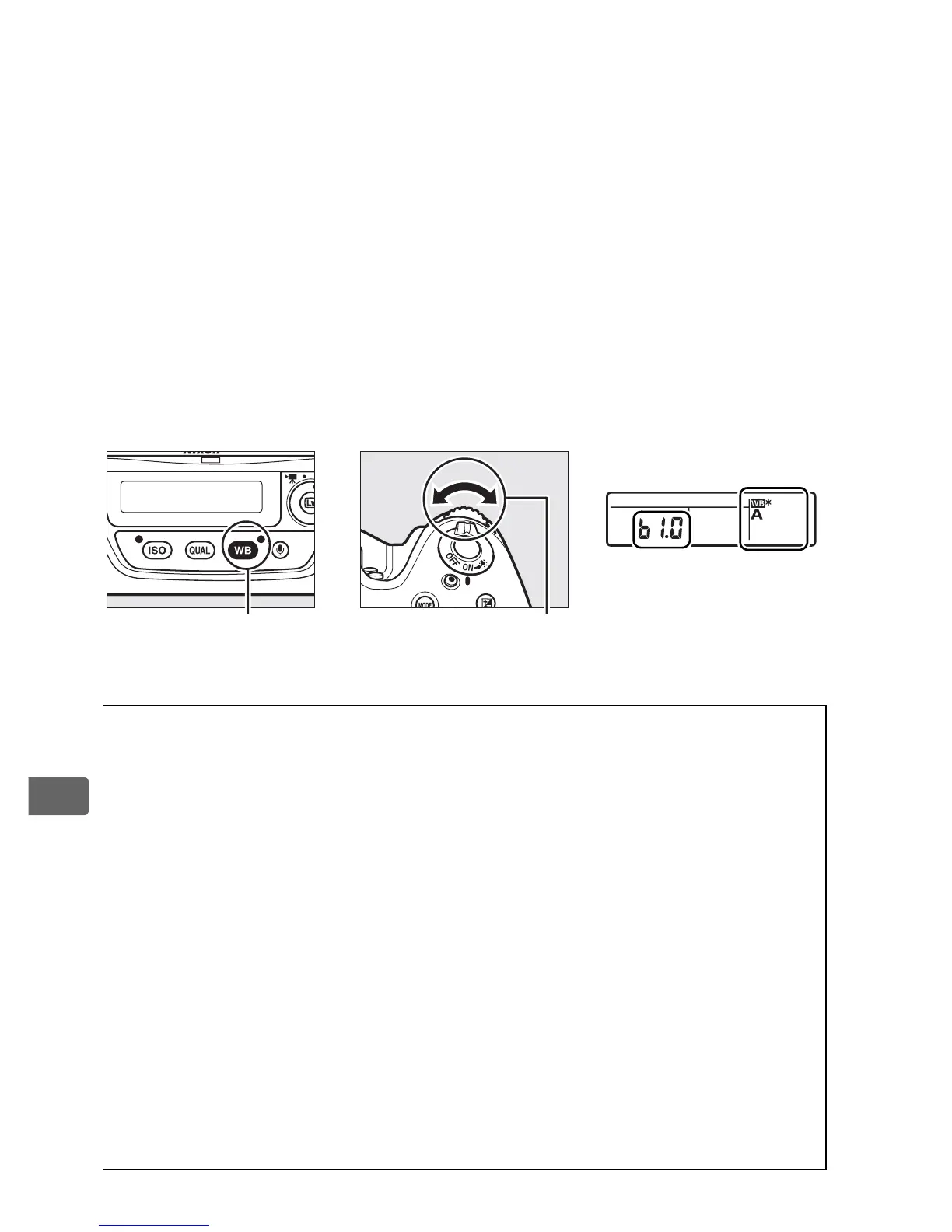
Press the U button and rotate the sub-command dial
to fine-tune white balance in steps of 0.5 (with each full increment
equivalent to about 5 mired) until the desired value is displayed in
the rear control panel.
Rotating the sub-command dial to the left
increases the amount of amber (A).
Rotating the sub-command
dial to the right increases the amount of blue (B).
At settings other
than 0, an asterisk (“U”) appears in the rear control panel.
Rear control panel
U button Sub-command dial
A White Balance Fine-Tuning
The colors on the fine-tuning axes are relative, not absolute.
For
example, moving the cursor to B (blue) when a “warm” setting such as
J (Incandescent) is selected for white balance will make photographs
slightly “colder” but will not actually make them blue.
A “Mired”
Any given change in color temperature produces a greater difference in
color at low color temperatures than it would at higher color
temperatures.
For example, a change of 1000 K produces a much
greater change in color at 3000 K than at 6000 K.
Mired, calculated by
multiplying the inverse of the color temperature by 10
6
, is a measure of
color temperature that takes such variation into account, and as such is
the unit used in color-temperature compensation filters.
E.g.:
• 4000 K–3000 K (a difference of 1000 K)=83 mired
• 7000 K–6000 K (a difference of 1000 K)=24 mired



 To Next Page