Model 976 7.1 Channel Preamp/Processor
13
Audio Formats and Listen
ing Modes
Audio Formats
With the exception of immersive audio formats such
as Dolby Atmos, the Model 976 supports almost any
audio format out there. These include lossy and lossless
digital audio formats used by Blu-ray and Internet video
streaming devices; the older digital audio formats used
by DVD and digital TV; and more generic audio data such
as analog, stereo PCM, and multichannel PCM. It also
includes additional processing modes that can be used
with certain of those formats. To assist in understanding
the supported input formats and processing modes of
the Model 976, we are devoting one section of this guide
to two separate subjects: audio formats (the incoming
audio data), and listening modes (the decoding and
processing schemes which can be applied to that audio
data).
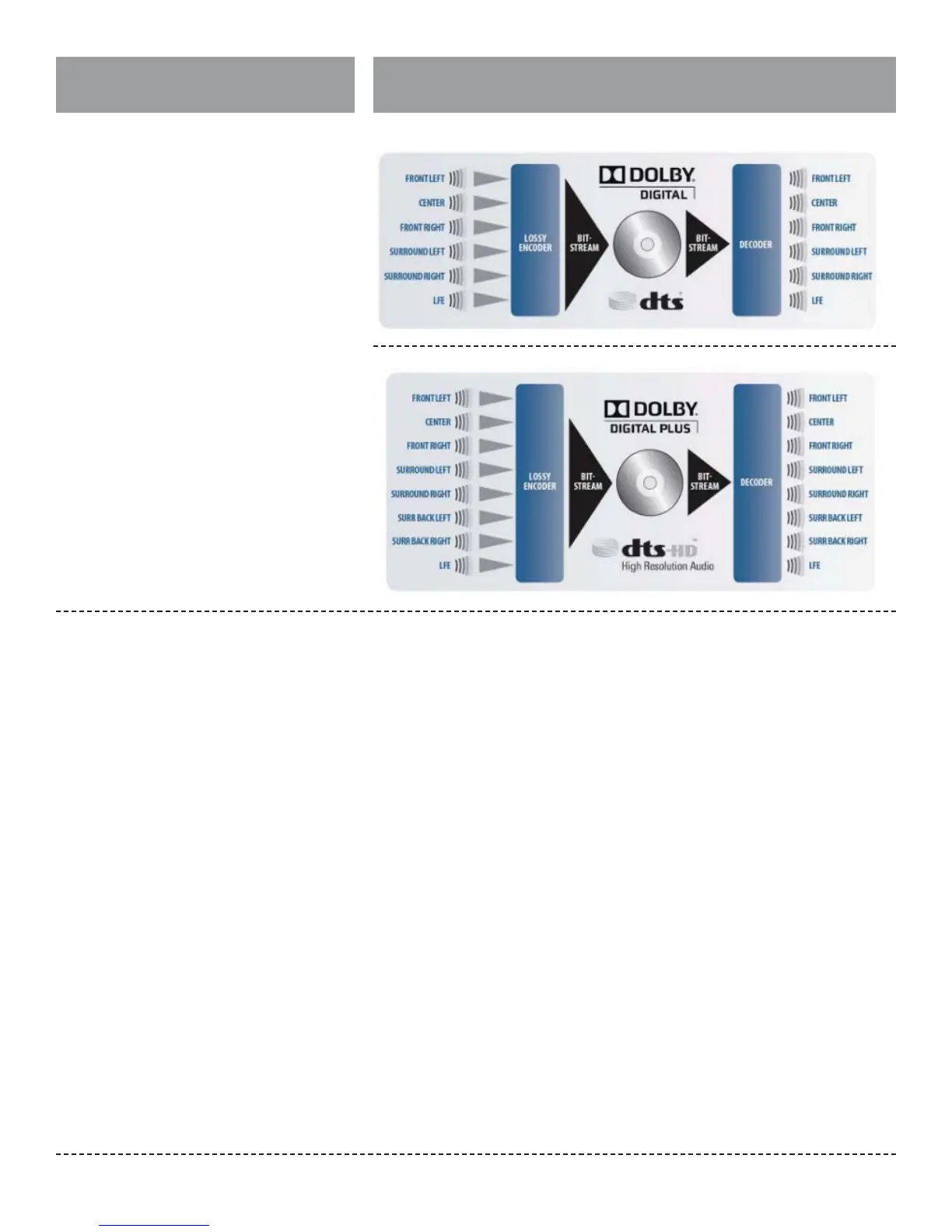
5.1 Multichannel Digital Audio
7.1 Multichannel Digital Audio
Analog Stereo and PCM Stereo
These two sources are NOT treated the same
way by the Model 976. The rst is analog stereo
connections, similar to what you might nd from
a VCR or some older game consoles (Nintendo
Wii, for example). The second is digital connec-
tions with stereo PCM signals, including sources
such as CDs and some digital cable channels.
The rst case (stereo analog) is kept pure analog
and is not a ected by the digital signal processor
(DSP). The PCM signals are a ected by the DSP
(and therefore the 976’s processing, such as EQ
and the application of additional listening modes)
and then converted to analog to send out to your
power ampli er.
Dolby Digital
Dolby Digital was rst called AC-3 when it ap-
peared in the 1990s on LaserDisc, and it was the
rst format to provide true multichannel digital
audio for consumer use. When the DVD speci ca-
tions were established a few years later, Dolby
Digital (often abbreviated “DD”) was included
as the default audio format. Dolby Digital o ers
up to ve discrete full-range channels (left, right,
center, left surround, and right surround) and
a low frequency e ects (LFE) channel; these six
channels are often referred to as “5.1” because the
LFE channel is limited to low frequency data only.
To allow these tracks to t on media such as DVD
and be passed across digital connections
originally designed for just two audio channels,
lossy compression is used to compact the
original data into a smaller size, allowing the
audio tracks to use much less space than would
be required for an uncompressed multichannel
track.
Dolby Digital soundtracks are not required to
use all six channels, so you will often encounter
Dolby Digital 2.0 tracks (stereo) or even Dolby
Digital mono tracks. Those mono tracks some-
times include two channels (left and right) with
identical data in both (or “Dolby Digital 2.0
Mono”), but other times they contain a single
channel (“Dolby Digital 1.0”).
Dolby Digital Plus
Dolby Labs developed a successor to Dolby
Digital for use with Blu-ray and Internet stream-
ing services. This audio format is called Dolby
Digital Plus (DD+). Dolby Digital Plus o ers up
to 7.1 discrete channels (extensible to 16 chan-
nels); it’s not limited to 5.1 discrete channels as
its predecessor was. It also employs more pow-
erful lossy compression, enabling both lower
bitrates and higher quality at higher bitrates.
Dolby TrueHD
Dolby TrueHD was developed for use with HD
disc formats such as Blu-ray Disc. The technol-
ogy is an extension of Meridian Lossless


 To Next Page