251
Driver assist systems
If ACC detects a vehicle ahead driving at a lower speed, the speed of the vehicle is
automatically reduced. ACC uses a radar sensor for detection. See section 'AEBS/ACC
sensor' in chapter 'Driver assist systems'.
The vehicle now drives at the same speed as the vehicle ahead and at a preset
distance behind it (depending on the vehicle speed). The set speed for the (Adaptive)
cruise control remains stored. As soon as the traffic conditions allow it, the vehicle
automatically accelerates back to the stored (Adaptive) cruise control speed.
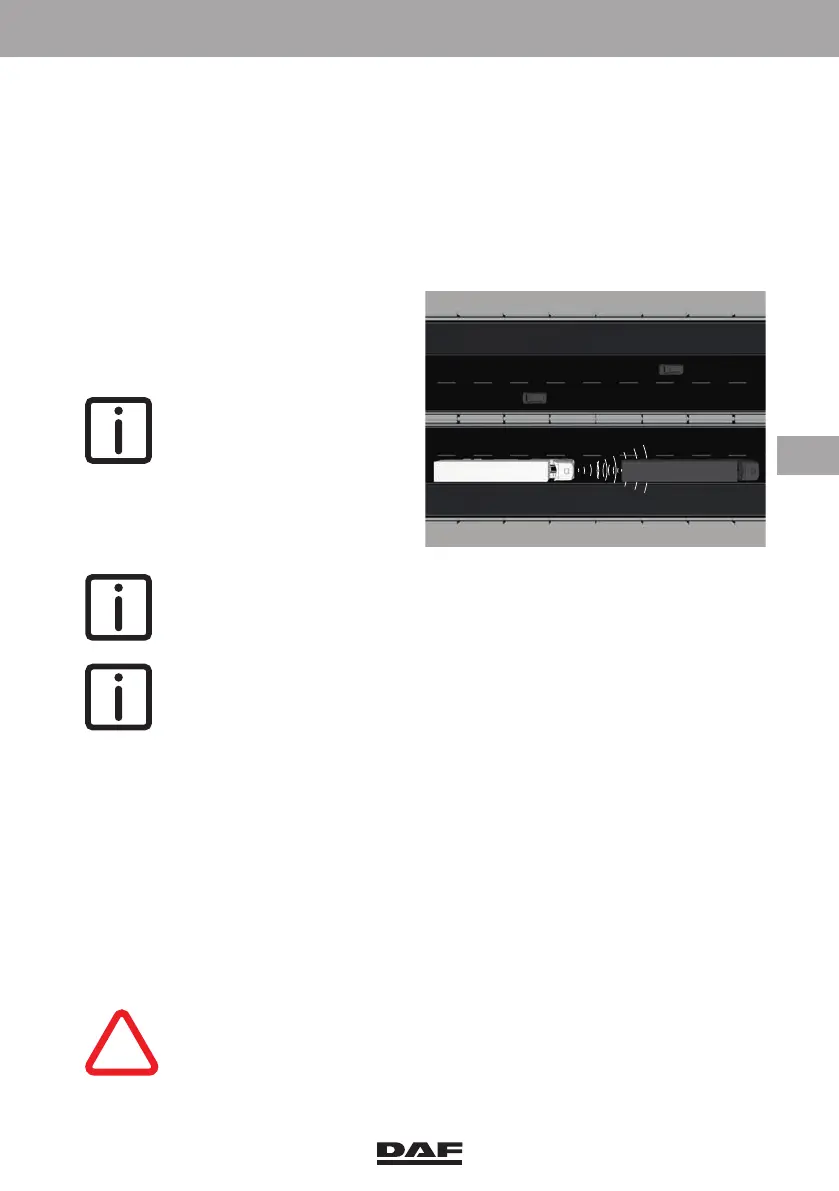
Object detection
ACC uses a radar sensor to detect
objects in front of the vehicle. See
section 'AEBS/ACC sensor' in chapter
'Driver assist systems'.
NOTE: The ACC system
only 'reacts' to objects in the
'Moving in the same
direction' category.
NOTE: ACC does not react to objects moving away from the vehicle
(overtaking vehicles, for example). This is because the distance between
them is increasing rather than decreasing.
NOTE: Vehicles with a low reflection (for example, motorcycles) may be
more difficult for the ACC to identify.
Speed adaptation
If ACC detects a vehicle ahead driving at a lower speed, the speed of the driven vehicle
is automatically reduced to the same speed as the vehicle ahead.
The following measures are taken for speed reduction, in the given order:
1. Reduction of engine torque.
2. Activation of the engine brake.
3. Activation of the intarder.
4. Activation of the service brake.
As a result of these measures, the gearbox may automatically shift down.
CAUTION: ACC does NOT brake the vehicle to a standstill.
If necessary, the ACC system brakes the vehicle down to 25 km/h (16
mph). Below this speed the ACC system is automatically switched off.
DW63246305.book Page 251 Friday, March 22, 2019 4:54 PM



 To Next Page