Service Modes, Error Codes, and Fault Finding
EN 28 JL2.1E AA5.
How to Order
• LVDS tool (incl. two LVDS cables: 31p and 20p):
3122 785 90671.
• LVDS tool Service Manual:
3122 785 00810.
• LVDS cable 31p/300/31p (for full HD displays):
3122 785 90861.
5.5 Error Codes
5.5.1 Introduction
The error code buffer contains all detected errors since the last
time the buffer was erased. The buffer is written from left to
right, new errors are logged at the left side, and all other errors
shift one position to the right.
When an error occurs, it is added to the list of errors, provided
the list is not full or the error is a protection error.
When an error occurs and the error buffer is full, then the new
error is not added, and the error buffer stays intact (history is
maintained), except when the error is a protection error.
To prevent that an occasional error stays in the list forever, the
error is removed from the list after more than 50 hrs. of
operation.
When multiple errors occur (errors occurred within a short time
span), there is a high probability that there is some relation
between them.
Basically there are three kinds of errors:
• Errors detected by the Stand-by Processor. These
errors will always lead to protection and an automatic start
of the blinking LED for the concerned error (see paragraph
“The Blinking LED Procedure”). In these cases SDM can
be used to start up (see chapter “Stepwise Start-up”). Note
that it can take up to 90 seconds before the TV goes to
protection and starts blinking the error (e.g. error 53)
• Errors detected by VIPER that lead to protection. In this
case the TV will go to protection and the front LED will blink
at 3 Hz. Depending on the software version it is possible
that further diagnosis via service modes is not possible
here (see also paragraph “Error Codes” -> “Error Buffer” -
> “Extra Info”).
• Errors detected by VIPER that do not lead to
protection. In this case the error can be read out via
ComPair, via blinking LED method, or in case you have
picture, via SAM.
5.5.2 How to Read the Error Buffer
Use one of the following methods:
• On screen via the SAM (only if you have a picture). E.g.:
– 00 00 00 00 00: No errors detected
– 06 00 00 00 00: Error code 6 is the last and only
detected error
– 09 06 00 00 00: Error code 6 was first detected and
error code 9 is the last detected error
• Via the blinking LED procedure (when you have no
picture). See next paragraph.
•Via ComPair.
5.5.3 How to Clear the Error Buffer
Use one of the following methods:
• By activation of the “RESET ERROR BUFFER” command
in the SAM menu.
• With a normal RC, key in sequence “MUTE” followed by
“062599” and “OK”.
• With a DST, key in sequence “DIAGNOSE” - “99” - “OK”.
• If the content of the error buffer has not changed for 50+
hours, it resets automatically.
5.5.4 Error Buffer
In case of non-intermittent faults, clear the error buffer before
you begin the repair (before clearing the buffer, write down the
content, as this history can give you significant information).
This to ensure that old error codes are no longer present.
If possible, check the entire contents of the error buffer. In
some situations, an error code is only the result of another error
code and not the actual cause (e.g., a fault in the protection
detection circuitry can also lead to a protection).
There are several mechanisms of error detection:
• Via error bits in the status registers of ICs.
• Via polling on I/O pins going to the stand-by processor.
• Via sensing of analogue values on the stand-by processor.
• Via a “not acknowledge” of an I
2
C communication
Take notice that some errors need more than 90 seconds
before they start blinking. So in case of problems wait 2
minutes from start-up onwards, and then check if the front LED
is blinking.
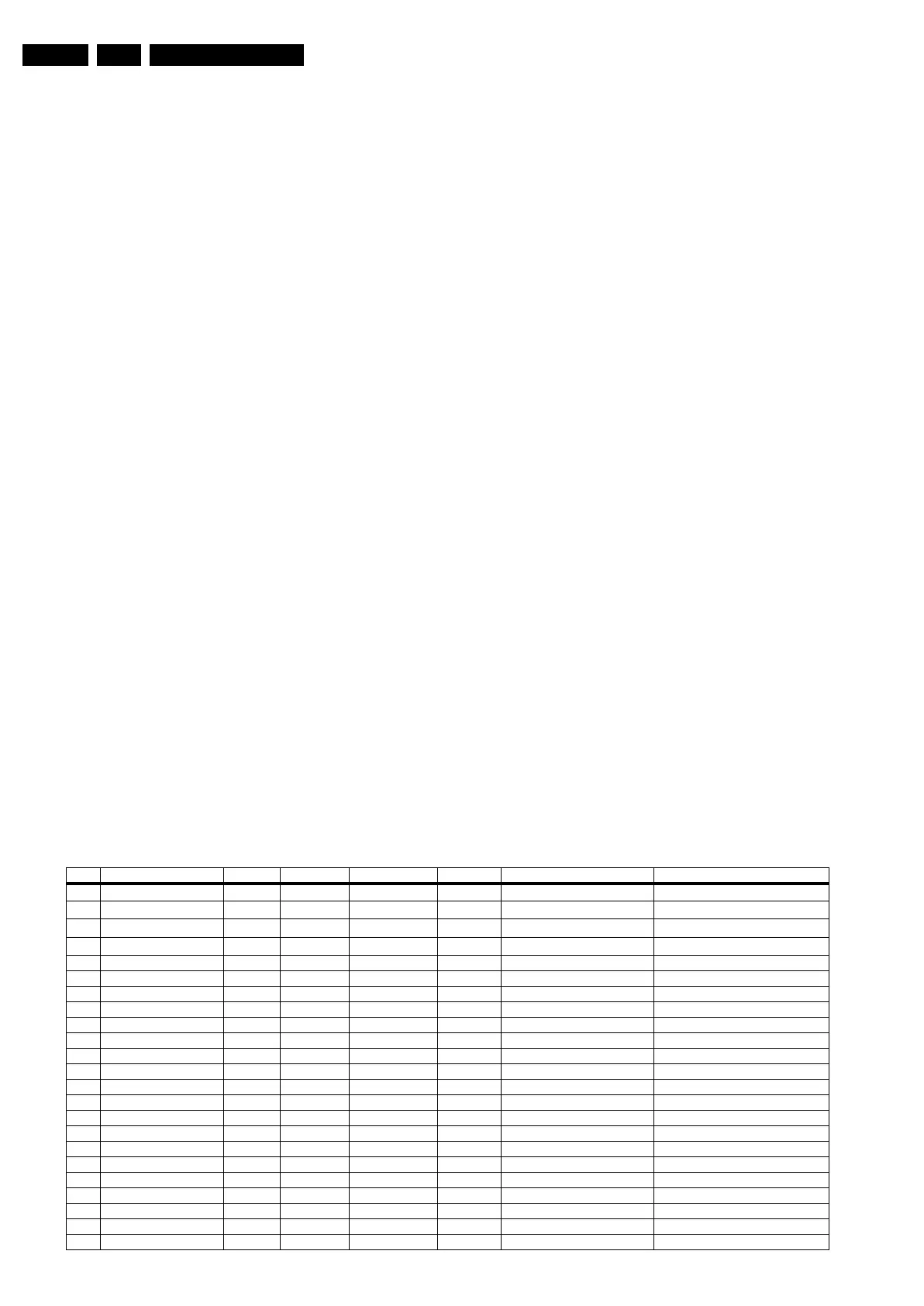
Table 5-3 Error code overview
Error Description Error/Prot Detected by Device Schematic Defective module Result
1
I
2
C1
P VIPER n.a. B7A
I
2
C1_blocked
Protection + 3 Hz blinking
2
I
2
C2
P VIPER n.a. B7A
I
2
C2_blocked
Protection + 3 Hz blinking
3
I
2
C3
P Stby µP n.a. B7A / Protection + Error blinking
4
I
2
C4
P VIPER n.a. B7A
I
2
C4_blocked
Protection + 3 Hz blinking
5 VIPER does not boot P Stby µP PNX8550 B7E / Protection + Error blinking
6 5V supply P Stby µP n.a. B8A / Protection + Error blinking
7 8V6 supply P Stby µP n.a. B8A / Protection + Error blinking
8 1.2V DC/DC P Stby µP n.a. B8A / Protection + Error blinking
9 2.5V DC/DC P Stby µP n.a. B8A / Protection + Error blinking
11 3.3V DC/DC P Stby µP n.a. B8A / Protection + Error blinking
12 12V supply P Stby µP n.a. B8A / Protection + Error blinking
14 Supply Class D amplifiers P Stby µP n.a. B8A / Protection + Error blinking
17 MPIF1 audio supply E VIPER PNX3000 B4D IF I/O Error logged
18 MPIF1 ref. freq. E VIPER PNX3000 B4B IF I/O Error logged
22 MPIF2 audio supply E VIPER PNX3000 B4H IF I/O Error logged
23 MPIF2 ref. freq. E VIPER PNX3000 B4F IF I/O Error logged
25 Supply fault P Stby µP n.a. B5E / Protection + Error blinking
27 Phoenix E VIPER PNX2015B B5E HD subsystem Error logged
28 MOP E VIPER XC3S B9D Output processor Error logged
29 AVIP1 E VIPER PNX2015 B5E AV input processor 1 Error logged
31 AVIP2 E VIPER PNX2015 B5E AV input processor 2 Error logged
32 MPIF1 E VIPER PNX3000 B4B Analog 1 front end 1 Error logged
33 MPIF2 E VIPER PNX3000 B4F Analog 1 front end 2 Error logged







 To Next Page