© PSI (Photon Systems Instruments), spol. s r. o.
38
The calibration of the CO
2
probe can be performed with assistance of PBR software (for more details see PBR Software
manual). Please follow also the instruction provided by the electrode manufacturer (www.mt.com) and instruction
described below.
There are three different ways one can use to calibrate the CO
2
electrode for use in PBR FMT150:
1. Using the gas mixing system and pure CO
2
calibration gas where known CO
2
gas mixtures are prepared and then
bubbled through the medium.
2. Using commercially prepared CO
2
gas mixtures in gas tanks, bubbling these into the medium.
3. Using standard concentration of calibration solution (NaHCO
3
and Na
2
CO
3
) and adding these to the medium.
Please note that in each case, the calibration procedure requires 3 concentration points and it takes about 12 hours. This
is due to time required for each CO
2
concentration to equilibrate in the solution and the slow response rate of the electrode
itself.
Below please find the guidelines for the CO
2
calibration based on use of standard calibration solutions (NaHCO
3
and
Na
2
CO
3
). Briefly, given amount of NaHCO
3
and Na
2
CO
3
is dissolved in deionized water to prepare standard calibration
solution. A known volume of the standard calibration solution is added to the Photobioreactor vessel completely filled
with deionized water that was aerated with N
2
to remove any residual CO
2
. The solution in the vessel is stirred with the
magnetic stirrer and the vessel is maintained closed during measurement so CO
2
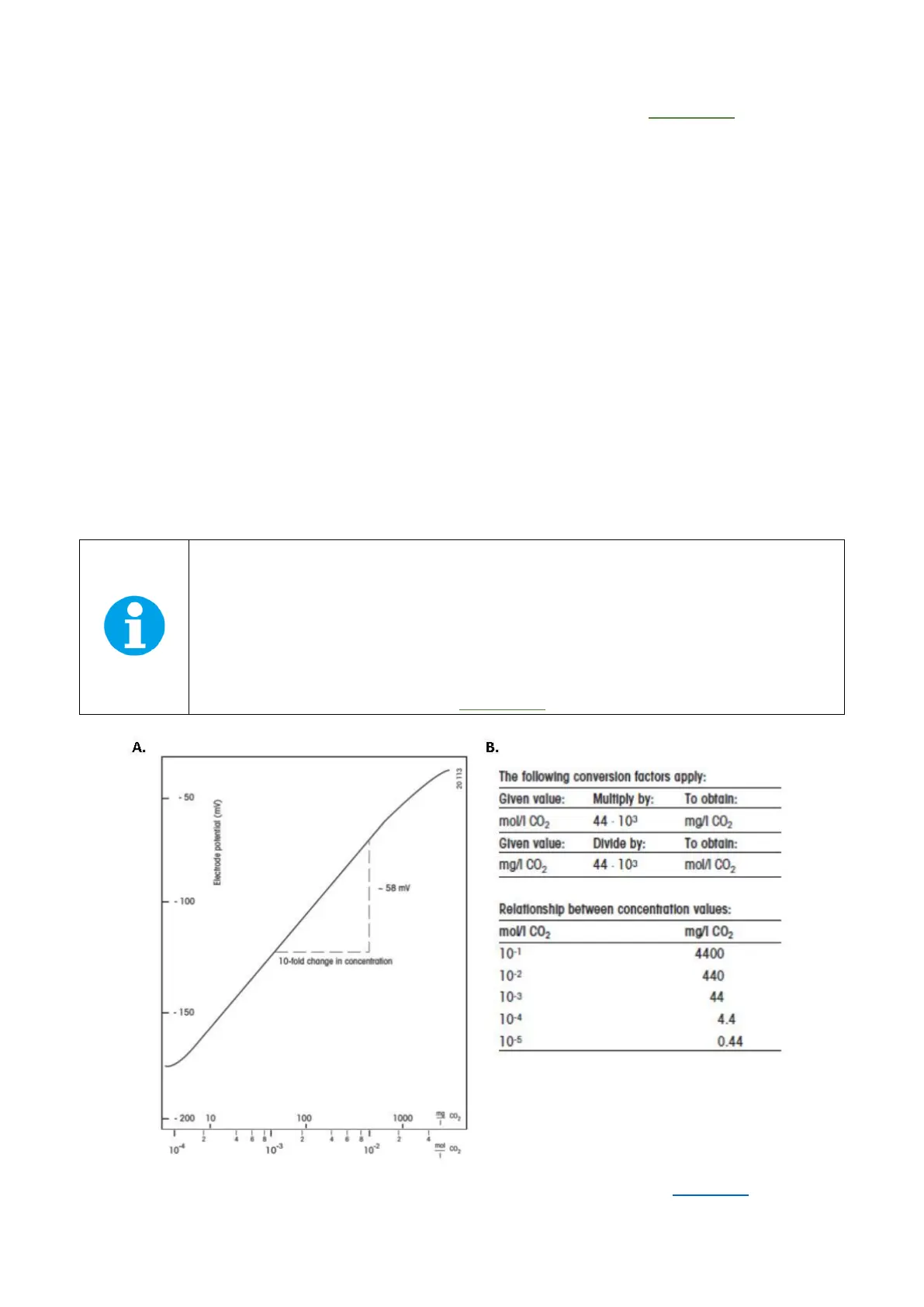
gas does not escape. Example of
calibration curve and table with concentration conversions factors is shown in Fig. 27.
Important: Please note that CO
2
electrode is designed for measurements of dissolved CO
2
in the
range from 6x10
-5
mol.l
-1
to 2x10
-2
mol.l
-1
CO
2
which corresponds to the lower limit of detection
around 60 µM dCO
2
(2,000 ppm in 25 °C). For measurements of dCO
2
close to ambient CO
2
concentration, it is recommended by the manufacturer to dilute supplied electrolyte solution 1:20
with distilled water and use it instead of the stock electrolyte solution. With 1:20 diluted electrolyte
solution the response of the sensor is faster and more precise in the lower range of dCO
2
concentration. For more information about the electrolyte solution please refer to information
provided by the electrode manufacturer (www.mt.com).



 To Next Page