PicoQuant GmbH HydraHarp 400 Software V. 3.0.0.1
1. Introduction
While fluorescence spectroscopic investigations are fairly common today, extracting additional temporal
information from molecules via laser induced fluorescence is a relatively new and much more powerful
technique. The temporal analysis can reveal information about the molecule not available from spectral data
alone. This is why lifetime analysis of laser induced fluorescence by means of Time–Correlated Single Photon
Counting (TCSPC) has gained importance over the recent years. The difference in the fluorescence decay
times of appropriate fluorescent dyes provides a powerful discrimination feature to distinguish molecules of
interest from background or other species. This has made the technique very interesting for sensitive analysis,
even down to the single molecule level.
The acquisition of fluorescence decay curves by means of TCSPC provides resolution and sensitivity that
cannot be achieved with other methods. In practice it is done by histogramming arrival times of individual
photons over many excitation and fluorescence cycles. The arrival times recorded in the histogram are relative
times between laser excitation and corresponding fluorescence photon arrival (start / stop times) ideally
resolved down to a few picoseconds. The resulting histogram represents the fluorescence decay. Although
fluorescence lifetime analysis is a main field of application for the HydraHarp, it is in no way restricted to this
task. Other important applications are e.g. Quantum Optics, Quantum Cryptography (QC) Time–Of–Flight
(TOF) and Optical Time Domain Reflectometry (OTDR) as well as any kind of coincidence correlation.
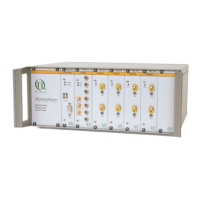
The HydraHarp 400 is a cutting edge TCSPC system with Universal Serial Bus (USB) interface. Its new
modular design provides a flexible number of input channels and allows innovative measurement approaches.
The timing circuits allow high measurement rates up to 12.5 million counts per second (Mcps) and provide a
time resolution of 1 ps. The modern USB interface provides high throughput as well as ‘plug and play’
installation. The input triggers are programmable for a wide range of input signals. All of them have a
programmable Constant Fraction Discriminator (CFD). These specifications qualify the HydraHarp 400 for use
with most common single photon detectors such as Single Photon Avalanche Diodes (SPADs) and
Photomultiplier Tube (PMT) modules (via preamplifier). The best time resolution is obtained by using Micro
Channel Plate PMTs (MCP–PMT) or modern SPAD detectors. The HydraHarp 400 is perfectly matched to
these detectors and the overall Instrument Response Function (IRF) can be as short as 30 ps FWHM.
Similarly, a wide range of excitation sources can be used, e.g. the interchangeable, easy–to–use LDH diode
laser series, as well as mode locked lasers such as a fs Ti:Sapphire laser. This permits lifetime measurements
down to under ten picoseconds with deconvolution, e.g. using the FluoFit Fluorescence Decay Fit Software.
The HydraHarp 400 can operate in various modes to adapt to different measurement needs. The standard
histogram mode performs real–time histogramming in on–board memory. Other modes are available via
software re-configuration. For instance, two different Time–Tagged–Time–Resolved (TTTR) modes allow
recording of each photon event on separate, independent channels, thereby providing unlimited flexibility in
off–line data analysis such as burst detection and time–gated or lifetime weighted Fluorescence Correlation
Spectroscopy (FCS) as well as picosecond coincidence correlation, using the individual photon arrival times.
The HydraHarp 400 is furthermore supported by a variety of accessories such as pre–amplifiers and an
optional hardware and software add–on allowing control of a monochromator from within the HydraHarp
software. The latter supports automated measurement of Time–Resolved Excitaion/Emission Spectra (TRES).
The HydraHarp software runs on all recent Windows PC platforms with Windows versions 7, 8 and 8.1,
including the x64 editions. It provides functions such as the setting of measurement parameters, display of
measurement results, loading and saving of measurement parameters and decay curves. Important
measurement characteristics such as count rate, count maximum and position, histogram width (FWHM) are
displayed continuously. Data can conveniently be exported via the clipboard, e.g. for immediate processing by
the FluoFit Fluorescence Decay Fit Software. An optional programming library (DLL) enables users to write
custom data acquisition programs for the HydraHarp in all modern programming environments.
For details on the Time–Correlated Single Photon Counting method, please read the next section as well as
our TechNote on TCSPC and consult the literature referenced at the end of section 2.4. Experienced users of
the method should be able to work with the HydraHarp straight away. Nevertheless, we recommend carefully
reading of the sections 3.2 and 3.3 on software and hardware installation to avoid damage. Later, the
comprehensive online–help function of the HydraHarp software will probably let the manual gather dust on the
shelf.
Page 5


 To Next Page