PicoQuant GmbH HydraHarp 400 Software V. 3.0.0.1
2. Primer on Time–Correlated Single Photon Counting
In order to make use of a powerful analysis tool such as time–resolved fluorescence spectroscopy, one must
record the time dependent intensity profile of the emitted light. While in principle, one could attempt to record
the time decay profile of the signal from a single excitation / emission cycle, there are practical problems to
prevent such a simple solution in most cases. First of all, the decay to be recorded is very fast. Typical
fluorescence from organic fluorophores lasts only a few hundred picoseconds to some hundred nanoseconds.
In order to recover fluorescence lifetimes as short as e.g. 200 ps, one must be able to resolve the recorded
signal at least to such an extent, that the exponential decay is represented by some tens of sample points in
time. This means the transient recorder required would have to sample at e.g. 10 ps time steps. This is hard to
achieve with ordinary electronic transient recorders of reasonable dynamic range. Secondly, the light available
may be simply too weak to sample an analog time decay. Indeed the signal may consist of just single photons
per excitation / emission. This is typically the case for single molecule experiments or work with minute sample
volumes / concentrations. Then the discrete nature of the signal itself prohibits analog sampling. Even if one
has more than just a single molecule and some reserve to increase the excitation power to obtain more
fluorescence light, there will be limits, e.g. due to collection optic losses, spectral limits of detector sensitivity or
photo–bleaching at higher excitation power. The solution is Time–Correlated Single Photon Counting (TCSPC).
Since with periodic excitation (e.g. from a laser) it is possible to extend the data collection over multiple
excitation/emission cycles, one can reconstruct the single cycle decay profile from single photon events
collected over many cycles.
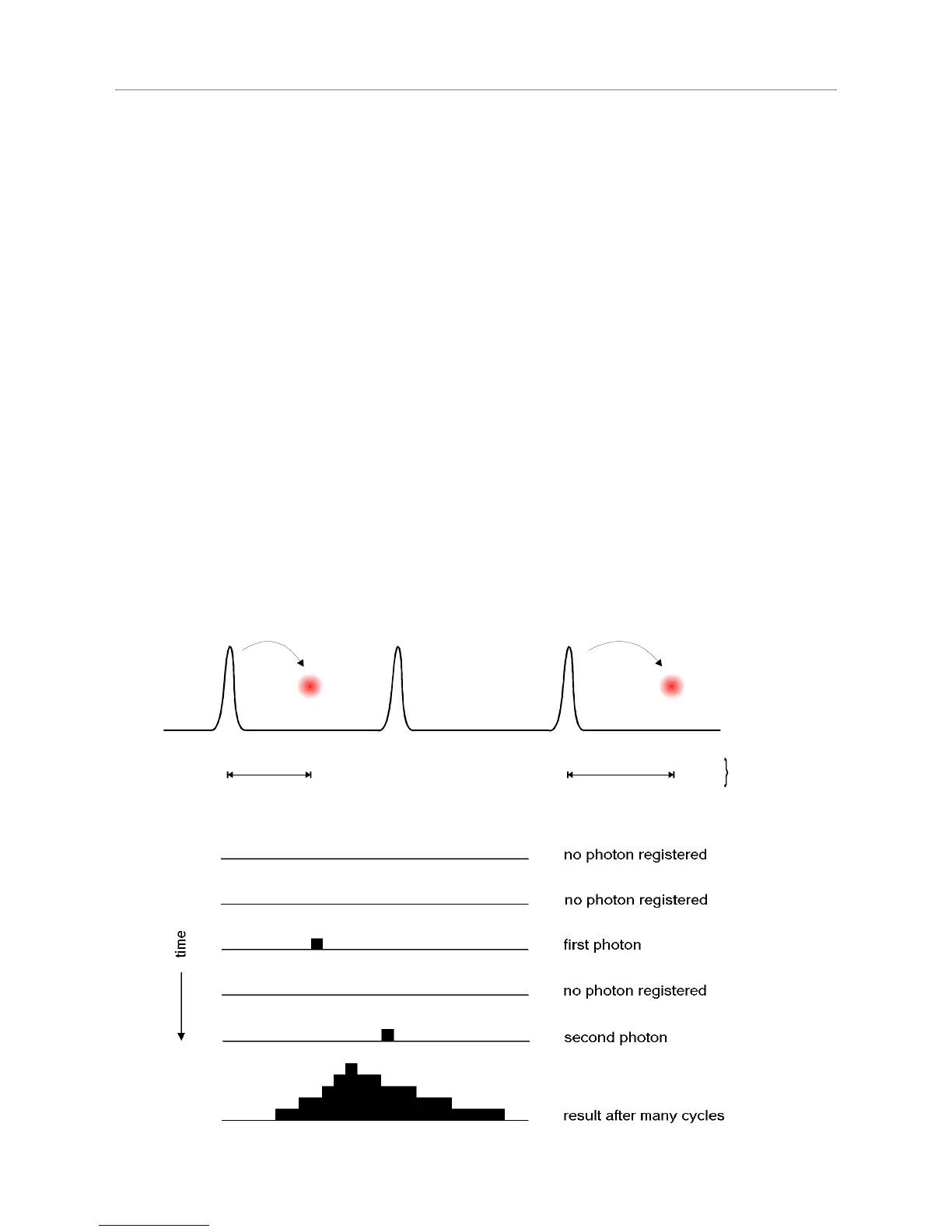
The TCSPC method is based on the repetitive, precisely timed registration of single photons of e.g. a
fluorescence signal. The reference for the timing is the corresponding excitation pulse. A single photon detector
such as a Photo Multiplier Tube (PMT) or a Single Photon Avalanche Photodiode (SPAD) is used to capture
the fluorescence photons. Provided that the probability of registering more than one photon per cycle is low,
the histogram of photon arrivals per time bin represents the time decay one would have obtained from a single
shot time–resolved analog recording. The precondition of single photon probability can (and must) be met by
attenuating the light level at the sample if necessary. If the single photon probability condition is met, there will
actually be no photons registered in many of the excitation cycles. The diagrams below illustrate how the
histogram is formed over multiple cycles.
Page 6


 To Next Page