PicoQuant GmbH HydraHarp 400 Software V. 3.0.0.1
and difficult to focus into. Single–photon detection probabilities of up to approximately 50 % are possible. APDs
are often noisier than PMTs, but can have a greater quantum efficiency. Maximum quantum efficiencies
reported are about 70 %. The popular commercial devices from Excelitas, formerly Perkin Elmer (SPCM–AQR)
provide a timing accuracy of ~400 ps and are specified to have a quantum efficiency of 60 %. These modules
are thermoelectrically cooled for low dark count rate and deliver pre–shaped TTL pulses. They are the most
common detectors for applications where NIR sensitivity is important, e.g. single molecule detection. To
achieve the specified timing accuracy, exact focusing into the center of the active area is necessary. More
recent SPAD designs such as the PDM family from Micro Photon Devices have the benefit of much better
timing resolution and robustness, however, at the expense of a lower sensitivity at the red end of the spectrum.
2.3.4. Other and Novel Photon Detectors
The field of photon detectors is still evolving. Recent developments that are beginning to emerge as usable
products include so called silicon PMTs, Hybrid PMTs, superconducting nanowire detectors and APDs with
sufficient gain for single photon detection in analog mode. Each of these detectors have their specific benefits
and shortcomings. Only a very brief overview can be given here.
Silicon PMTs are essentially arrays of SPADs, all coupled to a common output. This has the benefit of creating
a large area detector that can even resolve photon numbers. The drawback is increased dark count rate and
relatively high afterpulsing.
Hybrid PMTs make use of a combination of a PMT front end followed by an APD structure. The benefits are
good timing and virtually zero afterpulsing while the need for very high voltage is a disadvantage. The hybrid
PMT modules of PicoQuant's PMA Hybrid series alleviate this problem by encapsulating the high voltage
supply, the detector, a peltier cooler and even a protective shutter in a compact housing.
Superconducting nanowires (typically made from NbN) can be used to create photon detectors with excellent
timing performance and high sensitivity reaching into the infrared. The shortcomings for practical purposes are
the extreme cooling requirements and the low fill factor of the wire structures, making it difficult to achieve good
collection efficiencies.
Another class of potentially interesting detectors are recently emerging APDs with very high gain. In
combination with an electronic amplifier they have been shown to detect single photons. As opposed to Geiger
mode, this avoids afterpulsing and allows very fast counting rates. The disadvantage is a high dark count rate,
currently way too high for any practical TCSPC application.
2.4. Principles Behind the TCSPC Electronics
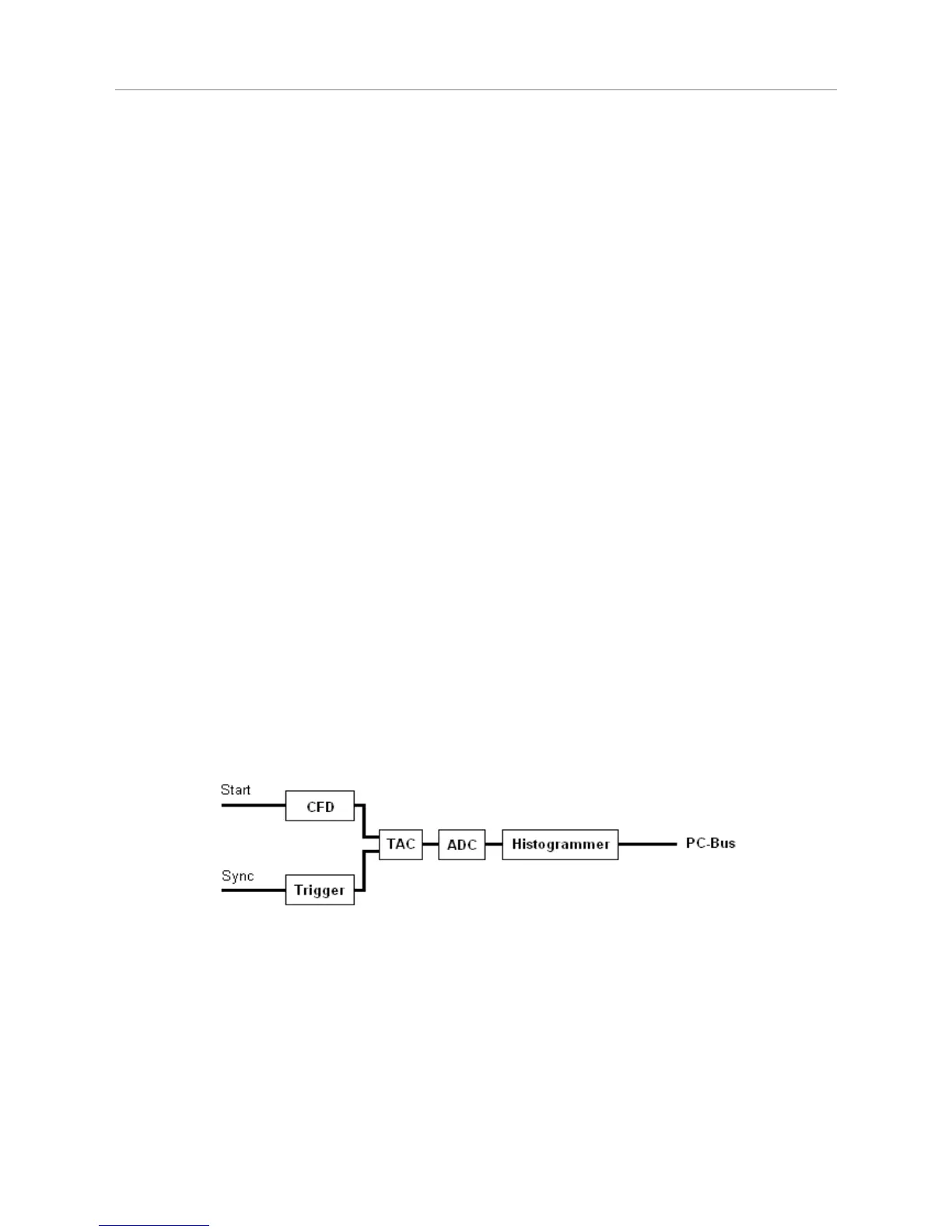
For introductory purposes it is worth looking at the design of conventional TCSPC systems first. They consist of
the following building blocks:
The CFD is used to extract precise timing information from the electrical detector pulses that may vary in
amplitude. This way the overall system IRF may be tuned to become narrower and some of the random
background signal can be suppressed. The same could not be achieved with a simple threshold detector
(comparator). Especially with PMTs, constant fraction discrimination is very important, because their pulse
amplitudes vary significantly. Particularly pulses originating from random electrons generated at the dynodes of
the PMT can be suppressed because their avalanches had less time to amplify, and their corresponding output
pulses are small.
Page 10


 To Next Page