6.1 Mechanical Installation
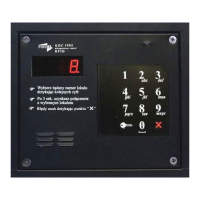
KDC1905 cassette can be installed in place of KDC18xx series keyboards after replacing the mounting box with a
new compatible cassette. The keyboard should be installed in a dedicated flush-mounted box, included with each
device. It is recommended to fix the cassette with two screws and two rivets. In case of outdoor installation it is
necessary to protect the device against water.
6.2 Electrical installation
For connecting the cassette to the system there is a connector on the back of cassette. Table 21 describes the outputs
from the PBX.
hot line cable for device lines
output of open collector type, e.g. enables connection of an external relay
(second terminal to +DC or to ground)
external lock button, the second terminal should be connected to ground (L-
or R-).
constant power supply voltage – enables to connect additional devices (e.g.
satellites) without the use of additional transformers
Table 21: Keyboard connector
To power the cassette it is required to supply a source of voltage in the range of 12-18V AC 50Hz. The +DC
connector in PBX version is the output terminal of the power source. In satellite cassettes, the +DC connector is
directly connected to the cassette power supply, so the connector can be used to power the cassette itself or to
connect the power supply to another device. It is not recommended to power multiple keyboards from one
transformer. Power supply from one transformer to more than one keyboard is possible only if the keyboards are
located at a short distance from each other, and the cables (especially the ground line and +DC) have a low
resistance (less than 1Ω).
Note! If more than one cassette is supplied by a transformer, the system should be tested for operation while the
lock is in operation. This is particularly important when using electromagnetic jumpers.
Connecting satellites to the system involves connecting the device in parallel to bus: LNK, GL, MIC and L-
(analog ground). Optionally, it is possible to connect a +DC line to power the satellite (if it is not powered by a
transformer – it does not apply to M-type keyboards).
1
Total resistance of L+ and L- cables must not exceed 10Ω, otherwise the manufacturer does not guarantee correct operation of the system
2
Note! The OC output should be protected with a diode connected in parallel to the load, or a zener diode, as shown in diagrams at t he end of
this manual.


 To Next Page