PRS 500 E
Instructions for use
5069-0-8002
PROTEC GmbH & Co. KG, In den Dorfwiesen 14, 71720 Oberstenfeld, Germany 11 von 47
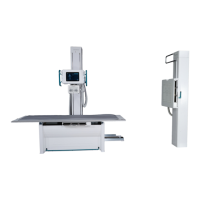
1.3.2 X-ray tube support stand
• Ceiling-free column stand intended for use within rooms with a ceiling height of at least 2.35 m
/ standard and 2.40 m / with rotation X-ray column.
• Wide range of application
• Small wall distance allows good use of space.
• Control elements on the command arm are handily placed.
• Reproducible position of the X-ray assembly when rotating around the support arm axis
through angle indicator.
• Vertical travel range, focus height from 29.7 cm to 189.6 cm with horizontal beam path
• Electromagnetic brakes for the longitudinal movement of the column stand, the vertical
movement of the support arm, for the rotation of the X-ray tube assembly around the support
arm axis +/-180° with additional 90 ° detents as well as for the transversal movement of the
support arm +230 mm (optional).
• Safety coupling for the automatic centring of the X-ray tube assembly with the X-ray cassette
holder (Bucky or Grid entity).
1.3.3 Image receptor floor stand
• Space-saving with a small footprint
• Wall and floor mounting or just floor mounting
• Left or right cassette loading
• Variable cassette / detector sizes can be used. Formats from 13 cm x 18 cm (5" x 7") to 43 cm x
43 cm (17" x 17"), depending on analogue or digital use.
• Suitable for a Bucky or a Grid entity (analogue or digital).
1.4 Intended use
The basic diagnostic X-ray systems of the PRS 500 series are intended for various routine applications in
planar X-ray imaging in human medicine.
They are stationary systems that can be used both for analogue and digital imaging.
1.5 Clinical Benefit
The clinical benefit of using diagnostic X-ray systems in human medicine is the generation of
conventional two-dimensional X-ray images for creation or specification of findings as a basis for
treatment decisions.
1.6 Patient Target Group(s)
The intended patient group includes all people for whom a justifying indication for a medical X-ray has
been given by a physician with the necessary expertise in radiation protection.
There are no general or fundamental restrictions on the patient group regarding age, gender, origin
and patient condition.
1.7 Medical Conditions to be diagnosed
A complete list of medical conditions that can be diagnosed is impossible for conventional
radiography, because the spectrum of conventional X-rays is very diverse and can vary in the course of
medical-technical progress.
Examples for medical conditions to be diagnosed:
• For the diagnosis of a bone fracture or bony injuries of the skeletal system or pathological
changes of hard tissues.
• For monitoring of correct reduction of bone fractures
• For the diagnosis of joint dislocations and ligament ruptures of the musculoskeletal system.
• For the diagnosis of degenerative, inflammatory, traumatic and tumorous diseases and
changes of the musculoskeletal system.
• For diagnostic of malformations and malalignments of the skeletal system.
• For the diagnosis of thoracic and pulmonary symptoms (thorax exposures)
• For the diagnosis of sclerotherapy.


 To Next Page