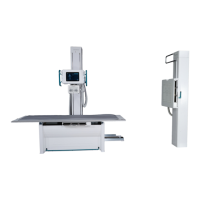
PRS 500 E
Instructions for use
5069-0-8002
PROTEC GmbH & Co. KG, In den Dorfwiesen 14, 71720 Oberstenfeld, Germany 16 von 47
2.1.4 Crushing and Collision Hazard
WARNING!
It must be ensured that when operating the moving parts of PRS 500 E, no
persons or objects are in the obvious danger area of the device. If not
observed, it can result in personal injury or damage to the PRS 500 E or other
objects.
2.1.5 Explosion protection
The PRS 500 E is not designated for use within areas with explosive hazards.
2.1.6 Radiation Protection
X-rays can pose a risk to patients and other people if the regulations for the operation of such systems
are not observed.
For this reason, the principles of radiation protection must have top priority and must be strictly
adhered to:
• Keeping distance from the radiation source
The dosage is reduced as a factor of the square of the distance from a (dot shaped) radiation source.
Double the distance ¼ dose, triple the distance 1/9 dose, etc.
The dose decreases with the square of the distance from a (point) radiation source, i.e. double
distance 1/4 dose, triple distance 1/9 dose, etc.
• Keeping exposure time as short as possible
The longer the exposure time, the higher the dose, i.e. halving the exposure time leads to halving
the dose, etc.
• Utilize shielding and protective clothing
The protection value increases exponentially with the thickness of the shielding, i.e. 2 half-value
layers weaken a (homogeneous) radiation to 1/4, 3 half-value layers to 1/8 and 10 half-value layers
to less than 1/1000 of the initial value.
• Do not reach into the direct X-Ray beam
The dose in the non-attenuated direct beam is about 100 times greater than that in the area of
scattered radiation.
• Utilize personal dosimeters
When working with radiation, dosimeters should be used for monitoring that are appropriate for the
activity.
The X-Ray exposures are principally triggered from behind a protective wall. When taking exposures
near the genital organs use the maximum available protection (e.g. gonad protectors or lead covers).
Persons who have to be in the vicinity of the patient must wear protective clothing (e.g. lead aprons).
The same applies to maintenance and repair work.
2.1.7 Ventilation
It must be ensured that the air exchange from the X-Ray generator in the system is not hindered. The
ambient air temperature must not exceed 40 °C.
2.1.8 Interaction with Other Devices
Interactions with other devices are not known.


 To Next Page