60
b) Conguring the wheel alignment
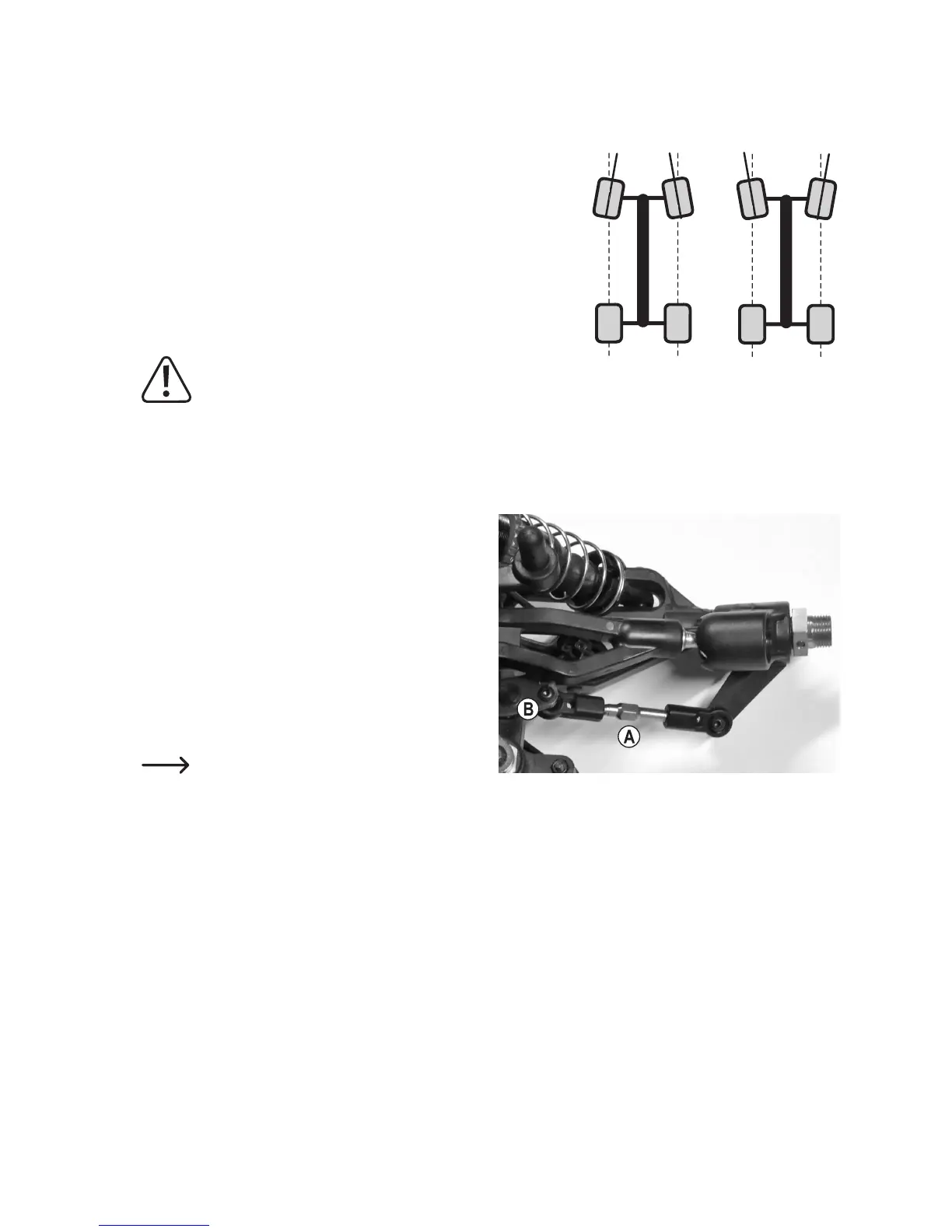
Thewheelalignment(toe-in=gureA,toe-out=gureB)describesthe
alignment of the wheel plane relative to the direction of travel.
When the vehicle moves, the tyres are pushed apart due to rolling
resistance. As a result, they are not parallel to the direction of travel.
To compensate for this, the tyres of the stationary vehicle can be adjusted
in a way so that they point slightly inwards. This toe-in improves the lateral
cornering of the tyre and therefore results in a more direct response to
steering commands.
To decrease the steering response, use toe-out (the wheels of the
stationary vehicle will point outwards).
A toe angle of more than 3° toe-in (A) or toe-out (B) may cause
steeringdifcultiesandreducesthespeed.Italsoincreases
tyre wear.
Thegureaboveshowsaheavilyover-emphasisedsetting.Itisonlyusedtoshowthedifferencebetween
toe-inandtoe-out.Ifasimilarsettingisusedforthevehicle,itwillbeverydifculttocontrol!
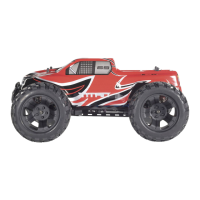
Setting the front axle toe:
Turn the steering arm (A) to adjust the toe-in/toe-out
forthefrontaxle.Thesteeringarmhasaleftandright-
handed thread, therefore you do not need to remove it
when making adjustments.
Always turn both steering arms by the same amount (left
and right front wheels), otherwise you will have to adjust
the trim on the remote control (or even adjust the servo
bar).
The angle joint (B) also has several attachment points for
the steering arm, which are used to change the turning
angle of the front wheel (Ackermann angle).
You should not change the attachment point (B)
because the manufacturer has already chosen
the optimal setting.
Setting the rear axle toe:
Therearaxletoeispre-setandcannotbechanged.
¦¦




 To Next Page