57
11. Vehicle conguration options
a) Conguring the camber
The camber is the inclination of the wheels as viewed from the front (vertical).
Negative camber Positive camber
(Upper wheel edge points inwards) (Upper wheel edge points outwards)
Thealignmentofthewheelsisexaggeratedinthetwodiagramstoshowthedifferencebetweennegative
andpositivecamber.Obviously,suchanextremeadjustmentshouldnotbemadetothemodelvehicle!
• A negative camber on the front wheels increases the lateral forces on the tyres when turning corners. This makes
the steering wheel more responsive and reduces the steering force. At the same time, the wheel is pushed onto the
axleleginthedirectionoftheaxis.Thisoffsetsaxialbearingclearanceandresultsinsmootherdriving.
• A negative camber on the rear wheels reduces the tendency of the rear of the vehicle to swing when turning corners.
• In contrast, a positive camber reduces the cornering force on the tyres and is generally not recommended.
Setting the front axle camber:
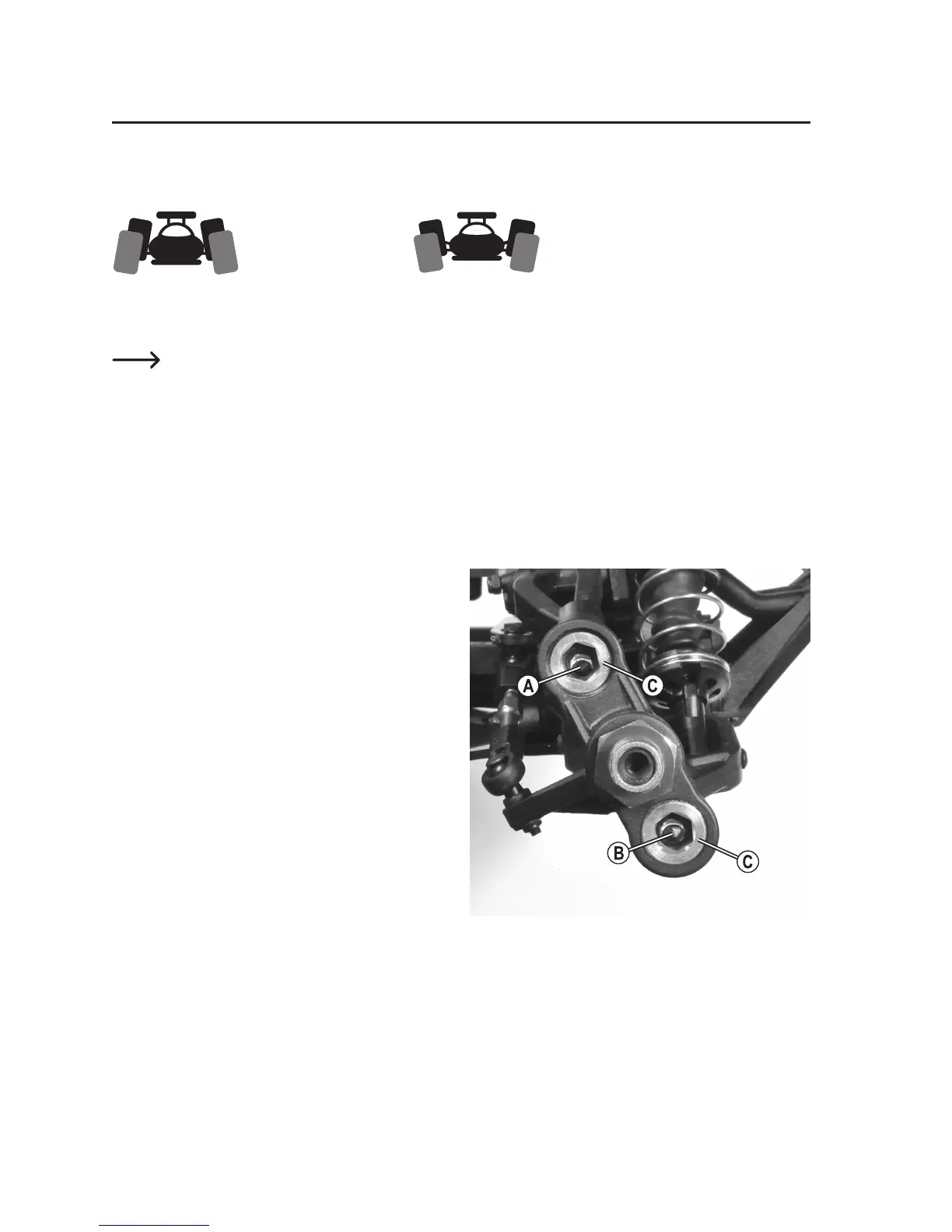
The"pivotball"suspensiononthefrontaxleconsistsof
a specially shaped steering knuckle, two spherical-head
screws (A) and (B) and two outer set screws (C).
To adjust the camber, turn the spherical-head screws (A)
and(B)usingasmall4mmhexkeyinsertedthroughthe
holeofthesetscrew(C)(seenextpage).
The set screws (C) can be tightened or loosened with a
slightlylarger8mmhexkeyorasuitablewrench.These
are only intended for xing the steering knuckle to the
spherical-head screws (A) and (B).
Never use force to tighten the set screws (C), as this
may prevent the wheel suspension from moving freely.
However, the set screws (C) must not be too loose,
otherwise the steering knuckle may wobble.




 To Next Page