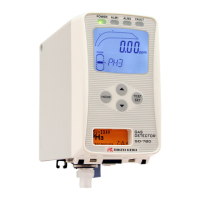
- 137 - GD-70D
<New Ceramic Type>
When a combustible gas burns on the surface of a highly active new ceramic oxidation catalyst in catalytic
combustion, the new ceramic-type sensor measures resultant temperature changes by measuring the
resistance changes in the heat-resistant alloy wire coil.
The sensor consists of two elements: A detecting element having a heat-resistant alloy wire coil with an
ultrafine particle (new ceramic) oxidation catalyst sintered on it together with a carrier and a temperature-
compensating element with a mixture of gas-inert alumina and glass sintered on it.
When a combustible gas comes into contact with the surface of the detecting element with new ceramic
oxidation catalyst sintered on it, the gas burns, causing the temperature to rise. In accordance with this
temperature change, there occurs a change in the resistance of a heat-resistant alloy wire coil that
constitutes the element. These resistance values are approximately proportional to gas concentrations.
From the changes in the resistance values, potential differences are obtained using a bridge circuit and
displayed as gas concentrations on the meter.
Special precautions for this principle
1. The detector is interfered by gases other than the gas to be detected, and vapors.
Please note that the alarm can be triggered by interference. In addition, the reading may be affected by
environmental (temperature, humidity, etc.) changes in the installation site.
2. The alarm must be set within a range where the performance of the detector can be ensured.
In facilities compliant with the High Pressure Gas Safety Act, an alarm setting below our standard
alarm setpoint may trigger a false alarm.
3. This is a safety device, not a control device.
The alarm contact output of the detector must be used for an external alarm lamp/buzzer, while the
alarm signal output must be used for an indicator or external recorder. If these outputs are used to
control other devices, we shall not be responsible for any malfunctions.
4. The gas sensing part of this detector is made of porous sintered bodies. If silicon or sulfide compounds
are accumulated on the surface of the porous sintered body, the area of the gas sensing part becomes
smaller, which may result in serious sensitivity deterioration.
For safety reasons, do not use the detector in the presence of silicon or sulfide compounds.
5. It is recommended that a regular maintenance and gas calibration are performed for every six months
in accordance with the regulations.
A
A
A
A
A
C: 補償素子
D: 検知素子
固定抵抗
ブリ ッ ジ平衡調整可変抵抗器
VR
SW
E
スイッ チ
電源
ブリ ッ ジ電圧
調整可変抵抗器
M
AAAA
固定抵抗
1. 3~1. 8mm
1. 4~1. 6mm
アルミ ナ担体
ニュ ーセラ ミ ッ ク
酸化触媒
耐熱合金線コ イ ル
AAA
耐熱材料
( セラミ ッ ク)
New ceramic oxidation
catalyst
re coil
Heat-resistant
material (ceramic)
Variable resistor for bridge equilibrium adjustment
Variable resistor for bridge
voltage adjustment


 To Next Page
 Loading...