32
ROTEX GCU compact -
5 x Start-up
6. In the programme [Emission Measurement] select the setting
[Base Load] (see chapter 15.2), but do not confirm.
– Make sure the heat can dissipate into the heating network
during emission meas
urement.
Ɣ Use the flue gas analyser to check the burner settings and
compare them with tab. 5-1 to tab. 5-3.
a) If the O
2
/CO
2
concentrations lie within the permissible
values:
Î No additional measures are required.
b) If the O
2
/CO
2
concentrations lie outside the permissible
values:
Î Carry out 100% calibration and adjust the [Drop Io-base]
in such a way that the setting range is reached (see
chapter 7.3.4) and repeat the measurement from step 5.
Ɣ Document the measured
values in the "Installation certifi-
cation" and in the operating manual.
7. End programme [Emission Measurement].
8. Set manual mode from the RoCon BF control (see operating
instructions "RoCon BF Control").
9. Check the resistance in the flue gas line (see chapter 4.5).
5.1.4 After start-up
Ɣ Mount the sound insulation hood (see chapter 4.4.3).
Ɣ Check all items on the "Checklist after start-up" (see
section 5.2).
Ɣ Log the test results on the checklist
.
Only when it is possible to answer all items on the checklist
with Yes, i
s it allowed to hand over the ROTEX GCU compact
to the operator.
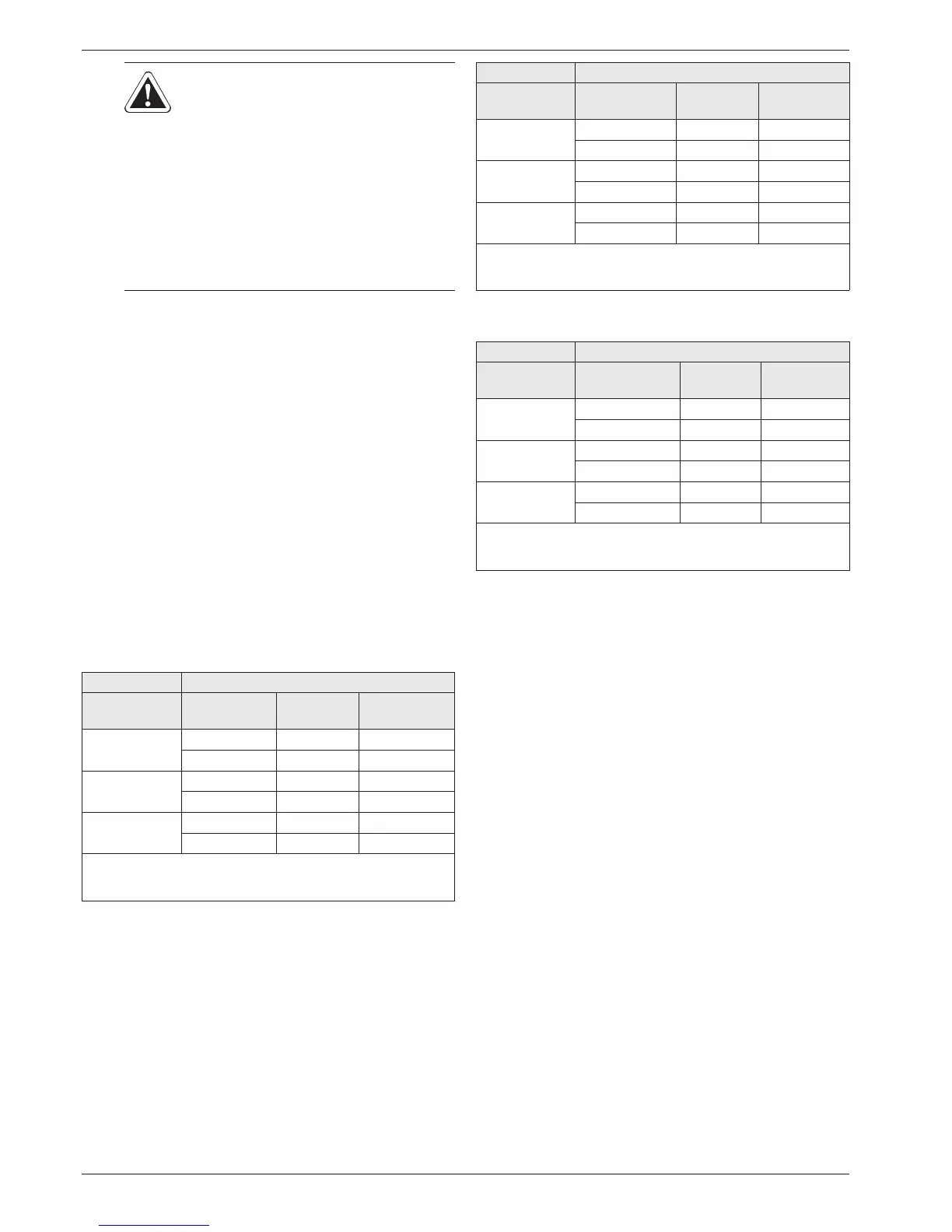
CAUTION!
The firing unit is programmed to take into
account the ageing of th
e components.
A 100 % calibration of the firing unit can have
a negative impact on th
e above even if the
exhaust setting values (tab. 5-1 to tab. 5-3) are
adhered to.
Ɣ Only carry out a calib
ration of the firing unit
when the exhaust setting values are not
adhered to, or when a mechanical change
was carried out, e.g. by replacing the
component with original ROTEX spare
parts.
Type GCU compact 315 / 515 (BIV)
Gas type
(Prüfgas)**
Burner load O
2
-content
in %
CO
2
-content
in %
Natural gas E/H
(G20)
Base Load 4.0 - 5.5 8.6 - 9.5
Full Load 4.0 - 5.4 8.7 - 9.5
Natural gas
LL
/L (G25)
Base Load 4.0 - 5.5 8.5 -
9.3
Full Load 4.0 - 5.4 8.5 - 9.3
Propane*
(G
31)
Base Load 4.0 - 5.5 10.0 -
11.2
Full Load 4.0 - 5.4 10.2 - 11.2
* Liquid gas setting
** Compare with the information on the yellow sticker attached to the burner
housing
Tab. 5-1 Start-up control values for GCU compact 315 and GCU
compact 515 for various gas types
Type GCU compact 324/ 524 (BIV)
Gas type (test
gas)**
Burner load O
2
-content
in %
CO
2
-content
in %
Natural gas E/H
(G20)
Base Load 4.0 - 5.5 8.6 - 9.5
Full Load 3.8 - 5.1 9.0 - 9.6
Natural gas
LL/L (G2
5)
Base Load 4.0 - 5.5 8.5 - 9.3
Full Load 3.8 - 5.1 8.7 - 9.4
Propane*
(G31)
Base Load 4.0 - 5.5 10.0 - 11.2
Full Load 3.8 - 5.1 10.4 - 11.3
* Liquid gas setting
** Compare with the information on the yellow sticker attached to the burner
housing
Tab. 5-2 Start-up control values for GCU compact 324 and GCU
compact 524 for various gas types
Type GCU compact 533 (BIV)
Gas type (test
gas)**
Burner load O
2
-content
in %
CO
2
-content
in %
Natural gas E/H
(G20)
Base Load 4.0 - 5.5 8.6 - 9.5
Full Load 3.5 - 4.9 9.0 - 9.8
Natural gas
LL
/L (G2
5)
Base Load 4.0 - 5.5 8.5 - 9.3
Full Load 3.5 - 4.9 8.8 - 9.5
Propane*
(G31)
Base Load 4.0 - 5.5 10.0 - 11.2
Full Load 3.5 - 4.9 10.5 - 11.4
* Liquid gas setting
** Compare with the information on the yellow sticker attached to the burner
housing
Tab. 5-3 Start-up control values for GCU compact 533 for various gas
types


 To Next Page