RTC
®
4 PC Interface Board
Rev. 1.3 e
4 Principle Of Operation
31
innovators for industry
F-Theta Objectives
By focusing the deflected laser beam with an F-Theta
objective, two of the three effects can be avoided:
• A direct proportionality between scan angle and
distance in the image field is obtained.
• Additionally, the focus lies on a flat surface.
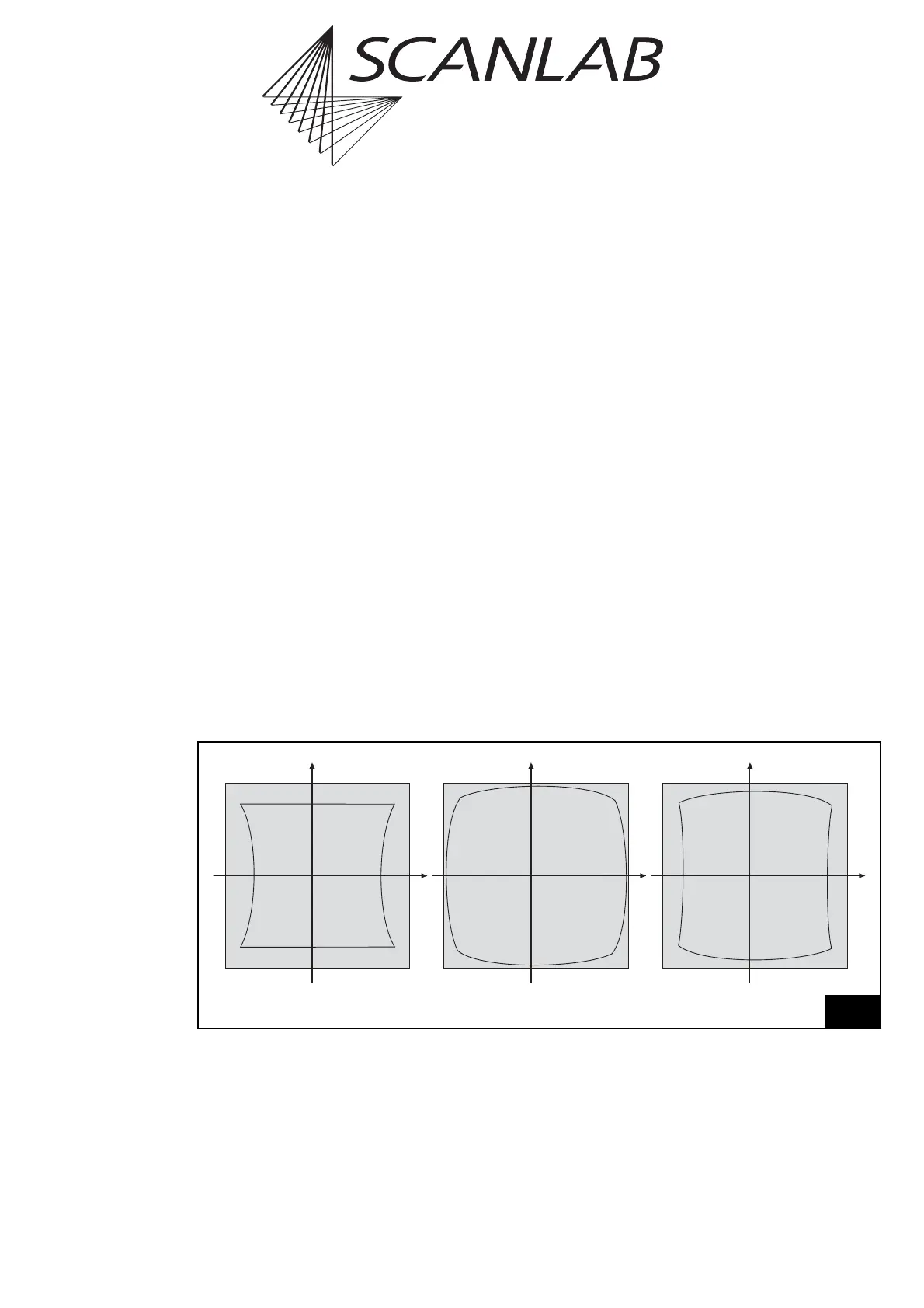
The F-Theta objective, however, causes a barrel-
shaped distortion of the image field, as depicted in
figure 15 on page 31, center. This distortion is added
to the pillow-shaped distortion described in section
(1) on page 30 (see figure 15 on page 31, left),
resulting in a so-called "barrel-pillow-shaped"
distortion of the image field – see figure 15 on
page 31, right.
Field Correction Algorithm
The RTC
®
4 board provides a correction algorithm to
compensate for the field distortion. The algorithm is
based on a correction table.
An orthogonal grid of 65 x 65 points is superimposed
on the ideal square image field. The adjusted X and Y
coordinates for the correct output of these grid
points are stored in a correction table. To move the
focus to any point within the image field, the RTC
®
4
calculates the correct coordinates by interpolating
from the grid points in the correction table. The result
is transmitted to the scan head. The correction algo-
rithm is executed for every single microstep.
(See the section "Microsteps", page 15.)
By default, SCANLAB creates an individual correction
table for every delivered system. It is stored in a file
named
*.CTB
in the RTC
®
4 software package. Also
see the command load_correction_file, page 95.
The calculation of the correction table is based solely
on general system data (such as mirror geometry,
calibration and the objective’s specifications).
Standard correction files therefore reflect neither the
unique properties possessed by the customer’s indi-
vidual system, nor alignment errors.
For those customers requiring more accurate
correction tables tailored to the unique properties of
their particular scan systems, SCANLAB offers two
programs: CFMP and correXion. These programs
generate RTC
®
4 correction files based on data
derived from actual test measurements performed by
the customer (for further information, refer to the
"correXion and CFMP" manual or contact SCANLAB).
15
Left: "pillow-shaped" field distortion caused by the arrangement of the mirrors
Center: "barrel-shaped" distortion caused by the F-Theta objective
Right: resulting, "barrel-pillow-shaped" field distortion



 To Next Page