12 Schaeer Technologies
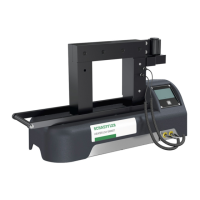
The operation of the heater is based
on inducing a (low frequency) current
in the bearing. This is achieved
by incorporating the bearing as a
secondary winding in a transformer.
The primary winding is connected to
the mains by means of an electronic
controller. The magnetic field induces
a high current (short-circuit current)
through the bearing, which then becomes hot. After each
heating cycle, the bearing or workpiece is demagnetized.
Schaeer induction heaters are intended for heating
bearings, so they can be assembled easily by means of a
shrink fit. Subject to professional assessment, they can also
be used to heat bushings, cogwheels, couplings and metal
objects that form a closed circuit. Bearings and workpieces are
demagnetized automatically after each heating cycle.
Bearings and workpieces can be heated to a maximum
temperature of 240ºC (464°F).
Schaeer induction heaters are suitable for continuous use.
However, when heating to a temperature of 240°C (464°F), do
not so for more than half an hour.
CAREFUL!
■ Bearings may be heated to a maximum of 120°C (248°F).
■ Precision bearings may be heated to a maximum
of 70°C (158°F). Higher temperatures can aect
metallurgical structure and lubrication, resulting in
instability and failure.
■ Do not use a heater for bearings and workpieces that
are outside the minimum and maximum dimensions
specified in the technical specifications.
■ Never switch o the unit with the main switch while it
is still heating up.
3.1 Application
3.2 Operating conditions ■ Only use the device indoors.
■ Fit for use in an industrial environment, at an ambient
temperature of 0ºC (32°F) to 50ºC (120°F) and humidity of
5 to 90% – non-condensing.
At temperatures below 0°C (32°F), the unit stops operating.
3.3 Principle of operation
3. Introduction


 To Next Page