Perimeter layout guidelines
Page 16 FlexZone Product Guide
Rigid fences
Service loops, zone demarcation loops and sensitivity loops are not recommended on rigid fences.
Therefore, the length of cable required on a rigid fence is approximately the length of the fence
plus 5% overage (for each cable pass).
Fence height recommendations
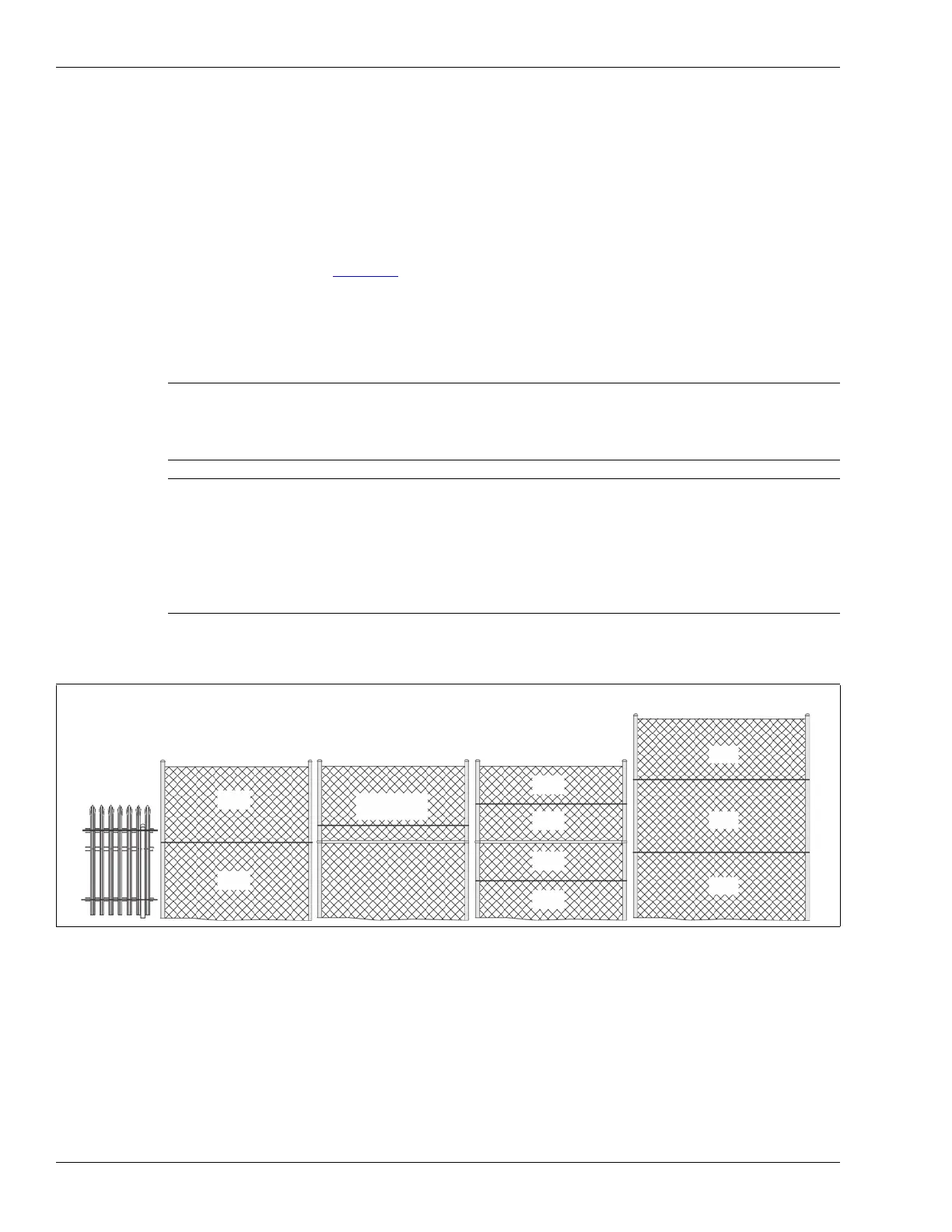
The following cable spacing recommendations will provide a high probability of detection on well
maintained fences (see Figure 8:
):
• For flexible fences up to 4.3 meters (14 ft.) tall - a single pass of sensor cable at 1/2 the fence
height.
• For flexible fences greater than 4.3 m tall - a double pass of sensor cable at 1/3 and 2/3 the
fence height.
• For rigid fences (minimum recommended fence height 2 m, 6.5 ft.) - a double pass of sensor
cable along the top and bottom rails.
Non-detecting cable
For instances where the processor is located away from the protected fence, outdoor rated,
shielded 75 Ohm coaxial cable with a solid copper center conductor can be used as lead-in cable
(e.g., RG6). For cable bypasses along the perimeter, FlexZone sensor cable is used. The bypass
cable is set to inactive (Zone 0) in software and will not report sensor alarms. Non-detecting
FlexZone cable must be well secured to prevent any cable motion. The length of coaxial cable that
is used for lead-in must be deducted from the detecting cable length
(maximum cable length detecting plus non-detecting = 300 m, 984 ft.).
Note If the lower edge of the fence fabric is embedded in a concrete
footing, or below ground, an additional cable pass may be required
on the lower section of fence (a double pass at 1/3 and 2/3 fence
height).
Note If the fence framework includes an intermediate (middle) rail, it
may require a double cable pass, with one pass above the rail and
one pass below the rail.
Senstar recommends installing a single pass of cable 30 cm above
the middle rail on a small section of the fence (4 or 5 panels) and
then thoroughly testing the protected section to determine if a
single cable pass meets your detection requirements.
Figure 8: Cable pass recommendations
max. h = 4.3 m (14 ft.)
1/2 h
1/2 h
1/3 h
1/3 h
1/3 h
single pass
double pass h > 4.3 (14 ft.)
1/4 h
1/4 h
1/4 h
1/4 h
double pass example
fences with a middle rail
h > 2 m (6.5 ft.)
double pass
rigid fences
flexible fences
30 cm (1 ft.)
above rail
single pass example


 To Next Page