7.2 Checking Site Suitability
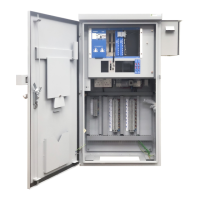
The controller outer case is installed to suit local conditions, but subject to the
following limitations:
(i) The position of the controller is as shown on the relevant site-to-scale drawing,
(STS)
(ii) No part of the controller is less than 457mm (18 inches) from the kerbside
unless agreed with the customer.
When it is necessary to site the controller less than 2 metres from the outer edge of
the kerb, the access doors and panels should not open over or toward the
carriageway. Where no pedestrian guard rails are fitted, then a clearance of at least
600mm shall be left between the outer case and kerb edge so that guard rails may
be installed at a later date without the need to disturb the controller installation.
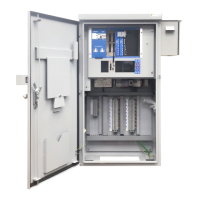
(iii) The controller door(s) should be easily accessible and not extend over the
roadway or obstruct the footpath when opened. The door describes an arc of
approx. 710mm radius from the left-hand front corner. Note that the controller door
swings open through 180.
(iv) Any person having control over the junction, whether manual control or
stimulating some other system interface to test the controller's response, MUST
have a good view of the intersection.
(v) When the controller is to be located on unmade ground (e.g. a grass verge) it is
recommended that paving slabs or a concrete standing be provided at ground level
under all access doors and panels. The hard standing shall extend a minimum
distance of 900mm away from the main doors, extending the full width of the case,
and at least 800mm away from the side of the case with a flap, again extending the
full width of that side.
Customers may specify particular requirements.
The door of the controller must have ground clearance of at least 30mm over its
whole opening arc.
7.2.1 Site Cable Installation
If new site cabling is being installed, refer to the following:
667/DS/20664/048 - Traffic Signal Junction Cable Design & Certification for ELV
Systems
If common neutral return connections are used it is possible for the
failure of a return connection to cause unexpected signal displays,
where one or more signals within a given signal head are incorrectly
illuminated simultaneously. This lack of neutral return connection is not
detectable by the controller because the signal voltage presented at the



 To Next Page