SigTEL Compact Installation and Configuration Manual
SigTEL Approved Document No. DAU0000091 Rev 5 Page 36 of 36
Emergency Voice
Communication System
21 Terms and Definitions
For the purposes of these instructions the following terms and definitions apply:
disabled persons toilet alarm (DPTA) interface
DPTA interfacing is a secondary function to the primary purpose of the system which is to act as an EVCS. Toilet
alarms can only be reset at the alarm point and cannot be reset by the EVCS. DPTA part number: NC951.
disabled refuge system
type of EVCS. A disabled refuge system connects hands-free Type B (disabled refuge) outstations to an MCU and
is used during a fire emergency to inform a responsible person that someone needs immediate assistance to
evacuate from the building.
emergency voice communication system (EVCS)
system that allows voice communication in either direction between an MCU and a number of other points throughout
a building, or building complex, particularly in a fire emergency situation. There are two types of EVCS; disabled
refuge systems and fire telephone systems. They may be separate, or they may be combined into one system and
are designed to operate reliably in a fire emergency.
extension
each MCU has either 16 extensions (ECU-16), eight extensions (ECU-8) or four extensions (ECU-4). One extension
typically has one outstation (Type A or B) or a DPTA connected to it.
fire telephone system
type of EVCS. A fire telephone system connects Type A outstations to an MCU and is used by management, marshals
at a sports ground and the fire service before, during and after a fire to communicate with fire marshals and fire
fighters.
line control unit (LCU)
control unit that controls the EVCS. On a networked system, up to 14 MCU and/or LCU can be installed. The LCU is
identical to an MCU but does not have a handset mounted on its front fascia. Part number: ECU-8NT.
master control unit (MCU)
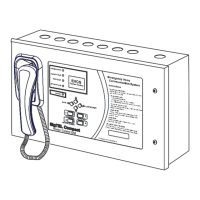
control unit that controls the EVCS. On a networked system, up to 14 MCU and/or LCU can be installed. The MCU
has a handset mounted on its front panel. Part number: ECU-16, ECU-8 or ECU-4.
master MCU
control unit on a network that has control over the EVCS, i.e. the ‘master’. Any other MCU on a network acts as a
repeater. The master MCU can give control to a repeater MCU by entering a security PIN code. There can only be
one master MCU at any one time. Part number: ECU-16, ECU-8 or ECU-4.
outstation
unit located at a strategic point in a building, or building complex, that allows two-way voice conversation with an
MCU. There are two types; Type A (fire telephone) and Type B (disabled refuge).
repeater MCU
control unit that forms part of a networked EVCS. They repeat messages displayed at the master MCU and have
ability to take control from the master MCU by entering a PIN code. Part number: ECU-16, ECU-8 or ECU-4.
type A (fire telephone) outstation
outstation that uses a telephone-style handset for communication. Part numbers: EVC301RPO/EVC301RLK.
type B (disabled refuge) outstation
outstation that uses hands-free operation and has a call/answer button, built-in microphone and loudspeaker. Part
numbers: EVC302S/EVC302GS or EVC302F/EVC302GF.


 To Previous Page