Need help?
Do you have a question about the Simrad RS90S and is the answer not in the manual?
Explanation of Marine Mobile Service Identity (MMSI) and Digital Selective Calling (DSC).
Procedures for powering the system on and off, including single/multiple handset scenarios.
Explanation of channel banks and how to change channels.
Adjusts radio sensitivity to minimize background noise.
Explains High (25W) and Low (1W) power settings.
Steps for making a ship-to-ship or ship-to-shore call.
How to call another vessel using its MMSI via DSC.
Procedures for making emergency calls on Channel 16/9 and via DSC.
How to use the hailer and fog horn features via a PA speaker.
Steps to create and save a new waypoint.
Procedures for modifying and removing existing waypoints.
How to select a waypoint for navigation or find the nearest one.
How to send waypoint data to a chart plotter.
Explains DSC, its purpose, and the call process.
Procedures for initiating, continuing, and receiving DSC distress calls.
Procedures for sending individual, group, all-ships, and relay calls.
Setting up buddy tracking and sending DSC test calls.
Overview of different types of DSC calls that can be received.
How to handle individual, all-ships, group, and geographic DSC calls.
How to view AIS data like MMSI list, PPI, and T/CPA.
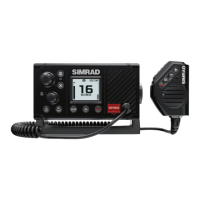
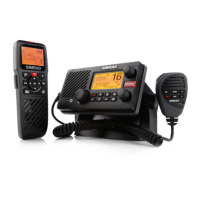
Lists items included in the RS90S radio package.
Guidelines for positioning the RS90S VHF radio transceiver.
Step-by-step instructions for mounting the transceiver unit.
Details for external connectors (VHF antenna, NMEA 2000) and internal connectors.
Instructions for installing the external GPS antenna.
Notes on radio setup, including MMSI entry and NMEA 2000 network connection.
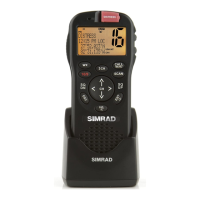
Procedure to subscribe wireless handsets to the transceiver.
How to set up the buddy list for DSC calls and tracking.
Entering individual MMSI and introduction to group MMSI.


 To Next Page

 General