Manual Integrator Supercal 531 06-06-2011 7
2. Concept of the Heat Meter
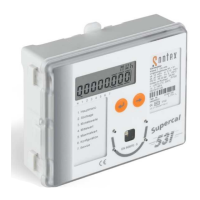
2.1 Measuring concept
The energy of a heat transfer medium is always calculated with its flow rate and the difference
between „temperature high“ and „temperature low“.
The heat capacity and the density of the heat transfer medium are also considered in this cal-
culation.
The flow rate is measured with an appropriate flow sensor.
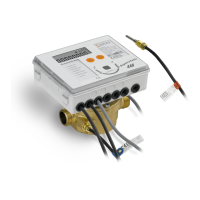
A temperature sensor pair detects the „temperature high“ and the „temperature low“ of the
heat transfer medium. As soon as ∆T > 0.2 K, the energy consumption is calculated.
For solar- or cooling systems, the medium heat capacity of the customer’s glycol mixture is
taken instead of the medium heat capacity of water (1.15 kW/m3 K).
Thus, the cooling energy is cumulated as soon as the temperature difference reaches < - 0.2
K and the „temperature high“ is < 18
o
C (the threshold value can be programmed freely).
2.2 Integrator
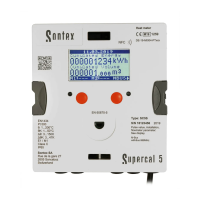
Modern integrators are required to fulfil a variety of customized and technical requirements, such
as:
Good readability of the displays of the integrator
Logical and clear design of the menu
Simple handling
Low costs in case of meter replacement
Flexibility with regard to the technical adaptation of different flow and temperature sensors
Modularity with regard to the device options such as data inputs and outputs etc.
High measuring precision and data safety
Normally, every integrator should be clearly assigned to one heat measuring point and be eas-
ily accessible/readable.
It is essential to avoid electro-magnetic disturbances and overheating at the place of installation.
All wiring has to be installed with a minimum distance of 300 mm from high-voltage and high-
frequency cables.
2.3 Flow sensors
Below, please find the possible / standard flow sensors:
Fluid Oscillator flow sensors
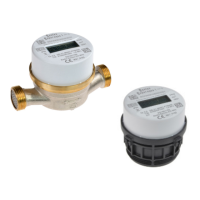
Impeller and turbine-type water meters
Magnetic-inductive flow sensors
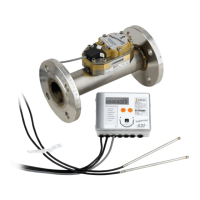
Ultrasonic flow sensors
The following operating conditions may influence the choice of the flow sensor:
Type of measurement (heat-/cold-metering, viscosity of the medium, etc.)
Mounting position
Precision requirements of flow sensor
Existing inlet-/outlet zones (accuracy of measurement)
Price-/performance ratio in general
Normally, a low pulse factor (output pulse of the flow sensor per flowing volume) is chosen to
achieve a resolution as high as possible.
Please pay attention to where the flow sensor is installed („cold side“ or „warm side“) since the
conversion from flowing volume into flowing mass is carried out on the basis of the temperature
assigned to the place of installation.


 To Next Page