EasyManua.ls Logo

Spirax Sarco BC3250 - User Manual

Spirax Sarco BC3250
76 pages
Print Icon
To Next Page IconTo Next Page
Loading...
OK
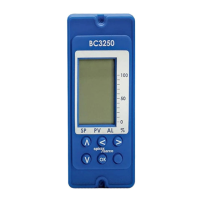
BC3250
100
50
0
%
SP
PV
AL
1. Safety information
2. User instructions and
delivery information
3. System overview
4. Mechanical installation
5. Electrical installation
6. Commissioning
- Quick set-up
- Full
7. Communications
8. Maintenance
9. Fault nding
10. Technical information
- Default settings
11. Appendix
- Summary of the
Modbus protocol
12. Menu map
IM-P405-89 EMM Issue 8
Commissioning password
Current legislation states that in order to prevent tampering and potentially
hazardous programming errors, access to the pass codes required to enter
commissioning mode should only be available to qualified and trained personnel.
Enter commissioning
This is done from the run mode by pressing and holding down the
OK
button for 5 seconds.
The bar graphs will disappear and the display will show 'PASS
CODE' with '8888' at the bottom right corner of the screen. The
flashing leading digit indicates the position of the cursor. The
default, or factory set pass code is 7452 but this can be changed
from within the commissioning mode. The pass code can be
entered by using the and buttons to increase or decrease
the flashing value and the and buttons to move the cursor.
Pressing
OK
will enter the pass code. If an incorrect pass code is
used, the display automatically returns to the run mode.
This page MUST be removed after
commissioning and kept in a safe,
access controlled location.
PASS
CODE
8888
© Copyright 2017
Printed in GB
IM-P403-89
EMM Issue 8
4033452 / 8
BC3250
Blowdown Controller
Installation and Maintenance Instructions
Question and Answer IconNeed help?

Do you have a question about the Spirax Sarco BC3250 and is the answer not in the manual?

Summary

Commissioning Password

Enter Commissioning

Accessing commissioning mode via the OK button for 5 seconds.

1. Safety Information

Safe Operation

Ensure safe operation via proper installation, commissioning, use, and maintenance.

Warning

Product modifications or improper use can cause injury or damage, invalidating CE marking.

EMC Compliance

Product complies with EMC Directive 2014/30/EU for industrial environments.

Static Precautions (ESD)

Observe ESD precautions to prevent product damage from static discharge.

Symbols

1.1 Intended Use

1.2 Access

1.3 Lighting

1.4 Hazardous Liquids or Gases in the Pipeline

1.5 Hazardous Environment Around the Product

1.6 The System

1.7 Pressure Systems

1.8 Temperature

1.9 Tools and Consumables

1.10 Protective Clothing

1.11 Permits to Work

1.12 Handling

1.13 Residual Hazards

1.14 Freezing

1.15 Disposal

1.16 Returning Products

2. User Instructions and Delivery Information

2.1 General Description

The BC3250 controls TDS by managing a blowdown valve and a timed bottom blowdown valve.

2.2 Front Panel

2.3 Using the Buttons

2.4 LCD Display

2.5 Trend Graph

2.6 Information Line

2.7 Viewing Parameters

2.8 Alarm; Error Display Messages

2.9 Equipment Delivery, Handling and Storage

3. System Overview

3.1 Function

The controller manages alarm and set point levels for TDS/conductivity control of boiler water.

3.2 Inputs

BC3250 accepts signals from conductivity probes and a Pt100 temperature sensor for measurement.

3.3 Outputs

3.4 Other Features

3.5 Typical Applications - Boiler Control Systems (BCS)

3.6 Typical Applications - Condensation Contamination Detection System (CCD)

System Description

CCD system monitors condensate return conductivity, diverting flow to drain if contamination is detected.

4. Mechanical Installation

4.1 Environmental Conditions

Install the product in an environment that minimizes effects of heat, vibration, shock, and electrical interference.

4.2 Installation on a DIN Rail

Instructions for mounting the unit onto a 35 mm DIN rail using the provided clip and screws.

4.3 Installation on a Chassis Plate

4.4 Installation in a Panel Cutout

5. Electrical Installation

5.1 General Wiring Notes

Essential precautions for safe electrical installation, including personnel qualification and compliance with standards.

5.2 Mains Wiring Notes

5.3 Blowdown Valve Wiring Notes

5.4 Signal Wiring Notes

5.5 Probe Wiring

5.6 Probe in Blowdown (or Condensate) Line - CP10

5.7 Probe in Boiler - CP30

5.8 Probe in Boiler - CP32

5.9 TP20 Temperature Probe Wiring

5.10 Four Wire Pt100

5.11 EIA; TIA-485 Communication Wiring Diagram

6. Commissioning

6.1 General Information

Commissioning is performed via the front panel; normal control stops during this process.

6.2 Commissioning Mode Navigation

6.2.1 Changing Parameters

Steps for altering parameters, including flashing digits and using navigation buttons.

6.3 Commissioning - Quick Set-up

6.4 Commissioning - Full

6.4.1 Main Menu Structure

Presents a flowchart of the main commissioning menu structure for program navigation.

6.4.2 MODE Sub-menu

6.4.3 DATA Sub-menu

6.4.4 INPUT Menu

6.4.5 INPUT - TDS Sub-menu

6.4.6 INPUT Sub Menu Notes

6.4.6.5 INPUT - TDS - CAL

6.4.7 OUTPUT Sub-menu

6.4.8 OUTPUT Sub-menu Notes

6.4.9 TIMER Sub-menu

6.4.10 ALARM Sub-menu

6.4.11 TEST Sub-menu

6.4.12 TEST INPUT Sub-menu

6.4.13 TEST OUTPUT Sub-menu

Software Version Sub-menu

Pass Code Sub-menu

Trend Sub-menu

7. Communications

7.1 Infrared (IR)

Enables parameter passing between adjacent controllers via an infrared bus.

7.2 RS485 Addressing

Explains RS485 addressing and offset for devices on an IR bus for network connectivity.

8. Maintenance

8.1 Cleaning Instructions

Use a damp cloth with tap/de-ionised water or isopropyl alcohol for cleaning.

8.2 TDS Controls

Boiler blowdown controls and alarms require regular testing and inspection.

8.3 General Weekly Maintenance

Weekly tasks include sampling water, checking calibration, blowdown valve, and stop valves.

8.4 General Six Months Maintenance

Six-monthly tasks involve probe removal/cleaning and examination of valves and fittings.

9. Fault Finding

9.1 Introduction

Most faults occur during installation/commissioning; the Test menu aids troubleshooting.

9.2 System Faults

9.3 Operational Error Messages

9.4 Determining the Probe Condition

10. Technical Information

10.1 For Technical Assistance

Information on obtaining technical assistance from Spirax Sarco representatives or their website.

10.2 Returning Faulty Equipment

Guidelines for returning faulty equipment, including necessary information and packing advice.

10.3 Power Supply

Specifies the mains voltage range (110-240 Vac) and maximum power consumption (7.5 W).

10.4 Environmental

10.5 Cable; Wire and Connector Data

10.6 Input Technical Data

10.7 Output Technical Data

10.8 Default Settings

10.8.1 MODE MENU

Lists default settings for the MODE menu (OPEN or CLOSE).

10.8.2 DATA MENU

Lists default settings for DATA menu units (Temp, TDS) and pH Term.

10.8.3 INPUT MENU

Lists default settings for INPUT menu: T COMP and TDS Sensor selection.

10.8.4 OUTPUT MENU

10.8.5 TIMER MENU - Bottom Blowdown (BB)

10.8.6 ALARM 1 MENU

10.8.7 TEST MENU

11. Appendix: Summary of the Modbus Protocol

Parameters and Register Data

12. Menu Map

Summary

Commissioning Password

Enter Commissioning

Accessing commissioning mode via the OK button for 5 seconds.

1. Safety Information

Safe Operation

Ensure safe operation via proper installation, commissioning, use, and maintenance.

Warning

Product modifications or improper use can cause injury or damage, invalidating CE marking.

EMC Compliance

Product complies with EMC Directive 2014/30/EU for industrial environments.

Static Precautions (ESD)

Observe ESD precautions to prevent product damage from static discharge.

Symbols

1.1 Intended Use

1.2 Access

1.3 Lighting

1.4 Hazardous Liquids or Gases in the Pipeline

1.5 Hazardous Environment Around the Product

1.6 The System

1.7 Pressure Systems

1.8 Temperature

1.9 Tools and Consumables

1.10 Protective Clothing

1.11 Permits to Work

1.12 Handling

1.13 Residual Hazards

1.14 Freezing

1.15 Disposal

1.16 Returning Products

2. User Instructions and Delivery Information

2.1 General Description

The BC3250 controls TDS by managing a blowdown valve and a timed bottom blowdown valve.

2.2 Front Panel

2.3 Using the Buttons

2.4 LCD Display

2.5 Trend Graph

2.6 Information Line

2.7 Viewing Parameters

2.8 Alarm; Error Display Messages

2.9 Equipment Delivery, Handling and Storage

3. System Overview

3.1 Function

The controller manages alarm and set point levels for TDS/conductivity control of boiler water.

3.2 Inputs

BC3250 accepts signals from conductivity probes and a Pt100 temperature sensor for measurement.

3.3 Outputs

3.4 Other Features

3.5 Typical Applications - Boiler Control Systems (BCS)

3.6 Typical Applications - Condensation Contamination Detection System (CCD)

System Description

CCD system monitors condensate return conductivity, diverting flow to drain if contamination is detected.

4. Mechanical Installation

4.1 Environmental Conditions

Install the product in an environment that minimizes effects of heat, vibration, shock, and electrical interference.

4.2 Installation on a DIN Rail

Instructions for mounting the unit onto a 35 mm DIN rail using the provided clip and screws.

4.3 Installation on a Chassis Plate

4.4 Installation in a Panel Cutout

5. Electrical Installation

5.1 General Wiring Notes

Essential precautions for safe electrical installation, including personnel qualification and compliance with standards.

5.2 Mains Wiring Notes

5.3 Blowdown Valve Wiring Notes

5.4 Signal Wiring Notes

5.5 Probe Wiring

5.6 Probe in Blowdown (or Condensate) Line - CP10

5.7 Probe in Boiler - CP30

5.8 Probe in Boiler - CP32

5.9 TP20 Temperature Probe Wiring

5.10 Four Wire Pt100

5.11 EIA; TIA-485 Communication Wiring Diagram

6. Commissioning

6.1 General Information

Commissioning is performed via the front panel; normal control stops during this process.

6.2 Commissioning Mode Navigation

6.2.1 Changing Parameters

Steps for altering parameters, including flashing digits and using navigation buttons.

6.3 Commissioning - Quick Set-up

6.4 Commissioning - Full

6.4.1 Main Menu Structure

Presents a flowchart of the main commissioning menu structure for program navigation.

6.4.2 MODE Sub-menu

6.4.3 DATA Sub-menu

6.4.4 INPUT Menu

6.4.5 INPUT - TDS Sub-menu

6.4.6 INPUT Sub Menu Notes

6.4.6.5 INPUT - TDS - CAL

6.4.7 OUTPUT Sub-menu

6.4.8 OUTPUT Sub-menu Notes

6.4.9 TIMER Sub-menu

6.4.10 ALARM Sub-menu

6.4.11 TEST Sub-menu

6.4.12 TEST INPUT Sub-menu

6.4.13 TEST OUTPUT Sub-menu

Software Version Sub-menu

Pass Code Sub-menu

Trend Sub-menu

7. Communications

7.1 Infrared (IR)

Enables parameter passing between adjacent controllers via an infrared bus.

7.2 RS485 Addressing

Explains RS485 addressing and offset for devices on an IR bus for network connectivity.

8. Maintenance

8.1 Cleaning Instructions

Use a damp cloth with tap/de-ionised water or isopropyl alcohol for cleaning.

8.2 TDS Controls

Boiler blowdown controls and alarms require regular testing and inspection.

8.3 General Weekly Maintenance

Weekly tasks include sampling water, checking calibration, blowdown valve, and stop valves.

8.4 General Six Months Maintenance

Six-monthly tasks involve probe removal/cleaning and examination of valves and fittings.

9. Fault Finding

9.1 Introduction

Most faults occur during installation/commissioning; the Test menu aids troubleshooting.

9.2 System Faults

9.3 Operational Error Messages

9.4 Determining the Probe Condition

10. Technical Information

10.1 For Technical Assistance

Information on obtaining technical assistance from Spirax Sarco representatives or their website.

10.2 Returning Faulty Equipment

Guidelines for returning faulty equipment, including necessary information and packing advice.

10.3 Power Supply

Specifies the mains voltage range (110-240 Vac) and maximum power consumption (7.5 W).

10.4 Environmental

10.5 Cable; Wire and Connector Data

10.6 Input Technical Data

10.7 Output Technical Data

10.8 Default Settings

10.8.1 MODE MENU

Lists default settings for the MODE menu (OPEN or CLOSE).

10.8.2 DATA MENU

Lists default settings for DATA menu units (Temp, TDS) and pH Term.

10.8.3 INPUT MENU

Lists default settings for INPUT menu: T COMP and TDS Sensor selection.

10.8.4 OUTPUT MENU

10.8.5 TIMER MENU - Bottom Blowdown (BB)

10.8.6 ALARM 1 MENU

10.8.7 TEST MENU

11. Appendix: Summary of the Modbus Protocol

Parameters and Register Data

12. Menu Map

Spirax Sarco BC3250 Specifications

General IconGeneral
Output4-20 mA
EnclosureIP65
ConnectionsScrew terminals
ApplicationBoiler control
Power supply50/60 Hz
Conductivity range0 - 10, 000 µS/cm
Temperature compensationAutomatic, 0-100°C
Alarm relays2 SPDT
MountingPanel mount

Related product manuals