5-20 Switches and controls
5 Exhaust brake
The exhaust brake enhances engine braking. Use it
as an auxiliary braking device on downhill stretches
or during high-speed driving.
Exhaust brake operation is different on manual and
automatic transmission vehicles. See the instruc-
tions below.
• Manual transmission vehicles
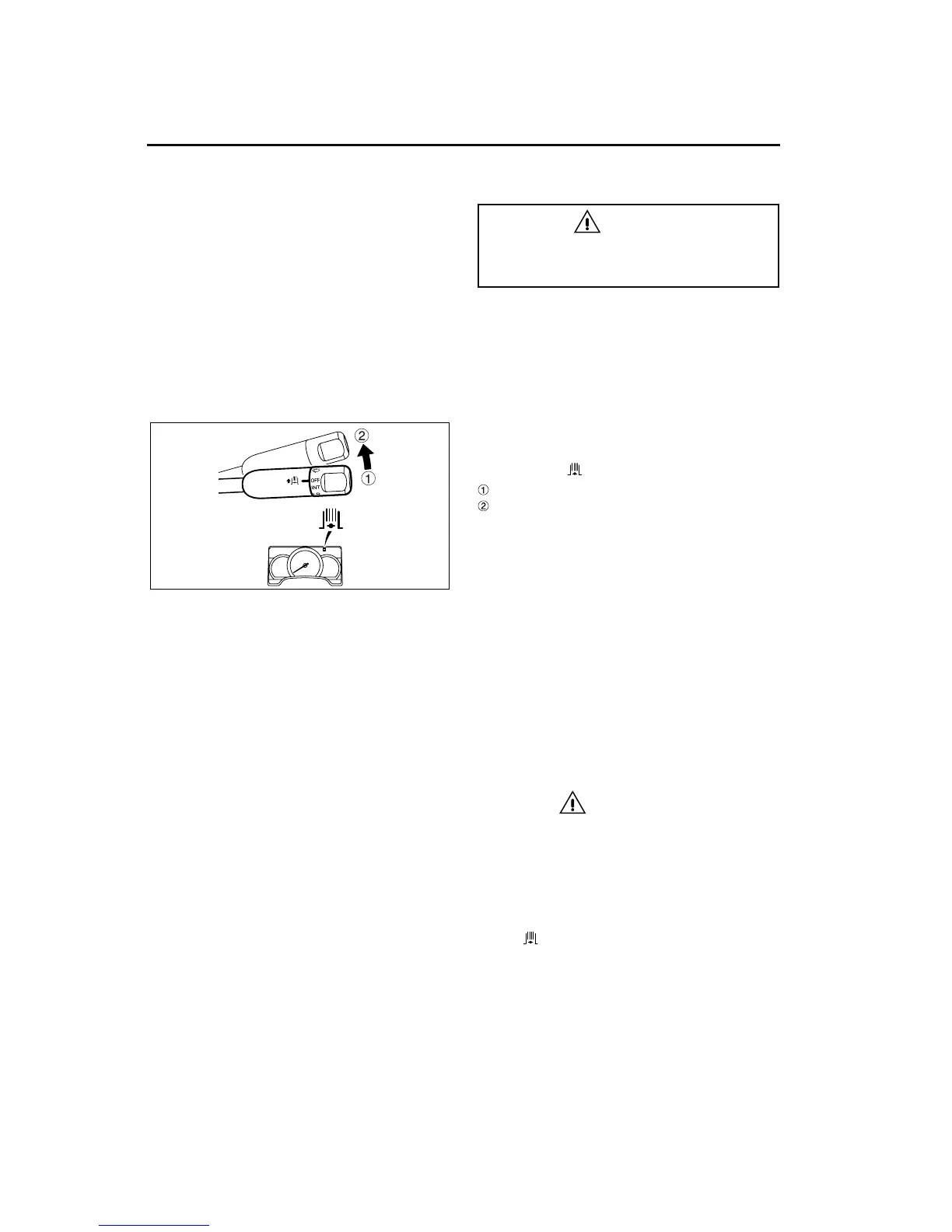
Push the lever away from you to turn ON the
exhaust brake. While the exhaust brake is ON, the
exhaust brake indicator illuminates.
Exhaust brake OFF
Exhaust brake ON
NOTE:
In a manual transmission vehicle, do not leave the
exhaust brake switch ON all the time. Too much use
of the exhaust brake reduces fuel economy. Use the
exhaust brake as necessary depending on road and
traffic conditions.
The exhaust brake will be temporarily disabled
under the following conditions:
• The accelerator pedal is depressed.
• The shift lever remains in neutral for 10 seconds
or longer.
• The antilock brake system (ABS) is operating.
Full exhaust brake function will return as soon as
the original conditions have been restored.
• Automatic transmission vehicles
CAUTION
Do not place the shift selector in “P” (park) or
“N” (neutral) while the vehicle is moving. This
would disable the exhaust brake but could
cause transmission damage.
To turn ON the exhaust brake, release the accelera-
tor pedal while the vehicle is in motion. The exhaust
brake indicator illuminates as long as the
exhaust brake is ON.
The exhaust brake will be temporarily disabled
under the following conditions:
• The accelerator pedal is depressed.
• The shift selector is moved to “P” or “N”.
• The temperature of the transmission fluid is too
high.
• The vehicle speed has dropped to 6 mph (10
km/h) or lower.
• The transmission is shifting gears.
• The antilock brake system (ABS) is operating.
WARNING
Do not use the exhaust brake on slippery
road surfaces. The vehicle may skid, causing
an injury accident or loss of life.
Z10814


 To Next Page