11-39
An excessively loose or tight belt could cause the
engine to overheat, the battery to be inadequately
charged, or the alternator or water pump to mal-
function. Always keep the belt adjusted to the
proper tension.
CAUTION
Do not allow the drive belt to come in contact
with oil or grease during this procedure.
If soiled with oil or grease, the belt will slip,
shortening its service life.
1Check
1. Set the parking brake and chock the front tires.
Tilt the cab. P. 11-4
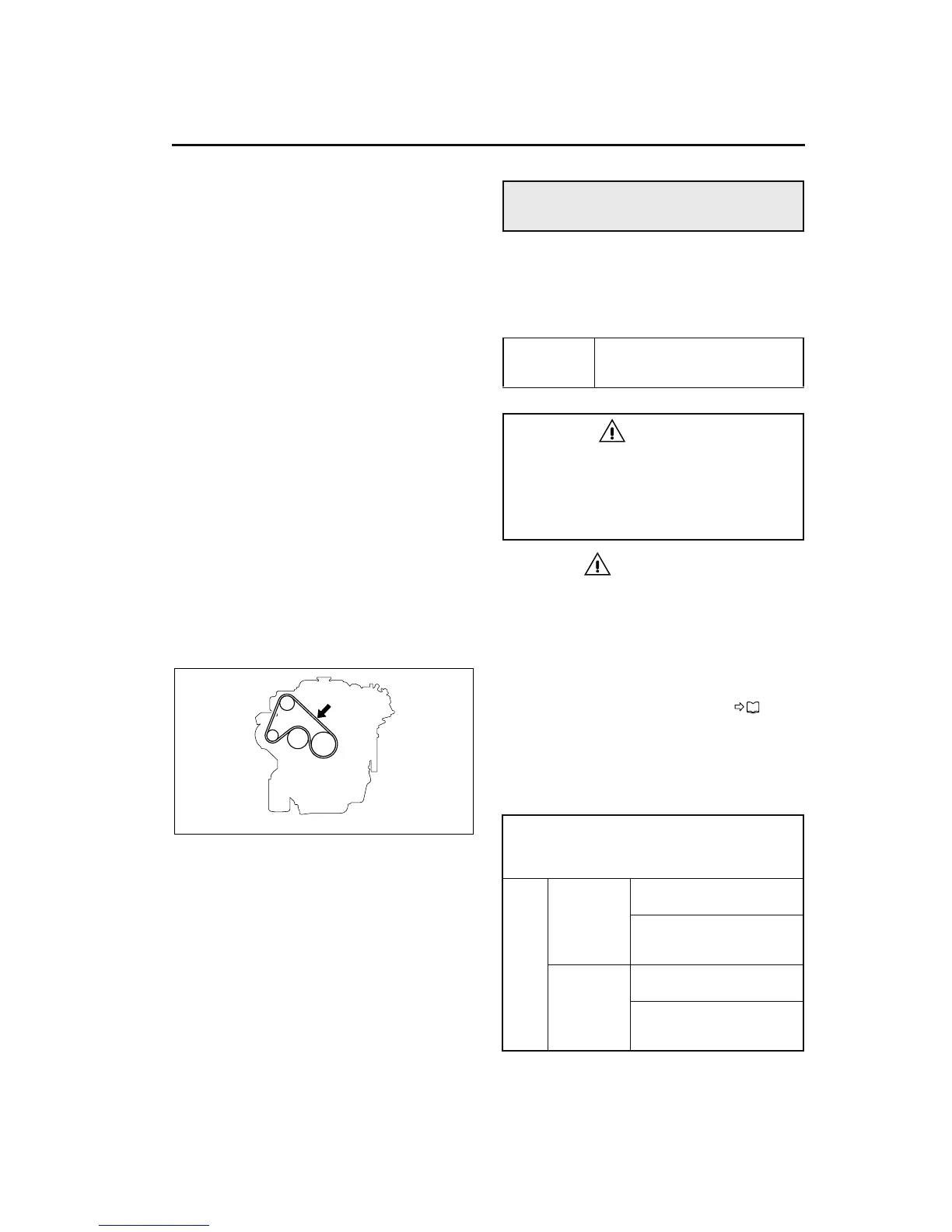
2. Press the belt with a force of around 22 lb (98 N)
at the point midway between the pulleys, and
measure the amount of deflection.
3. If necessary, adjust the belt tension until the belt
deflection is within the limits given in the table
below.
4. Check the belt for damage. Replace the belt if
damage is found.
Drive belt checking and adjusting
Inspection
intervals
Daily pretrip inspection and
every 6000 miles (10 000 km)
or every 12 months
WARNING
Always shut down the engine before inspect-
ing or adjusting belts. A moving drive belt
can cause a serious injury or loss of life.
Ensure that the engine cannot be started
while you are performing checks or adjust-
ments.
Belt tension
[Amount of deflection when the belt is pressed
with a force of 22 lb (98 N) at the point
midway between the pulleys]
Drive
belt
Vehicles
without air
conditioner
New belt (when installed):
0.35 to 0.43 in (9 to 11 mm)
Used belt (when inspected
or reinstalled): 0.43 to 0.51
in (11 to 13 mm)
Vehicles
with air
conditioner
New belt (when installed):
0.28 to 0.35 in (7 to 9 mm)
Used belt (when inspected
or reinstalled): 0.39 to 0.43
in (10 to 11 mm)
Z11933


 To Next Page