7-10 Starting and driving
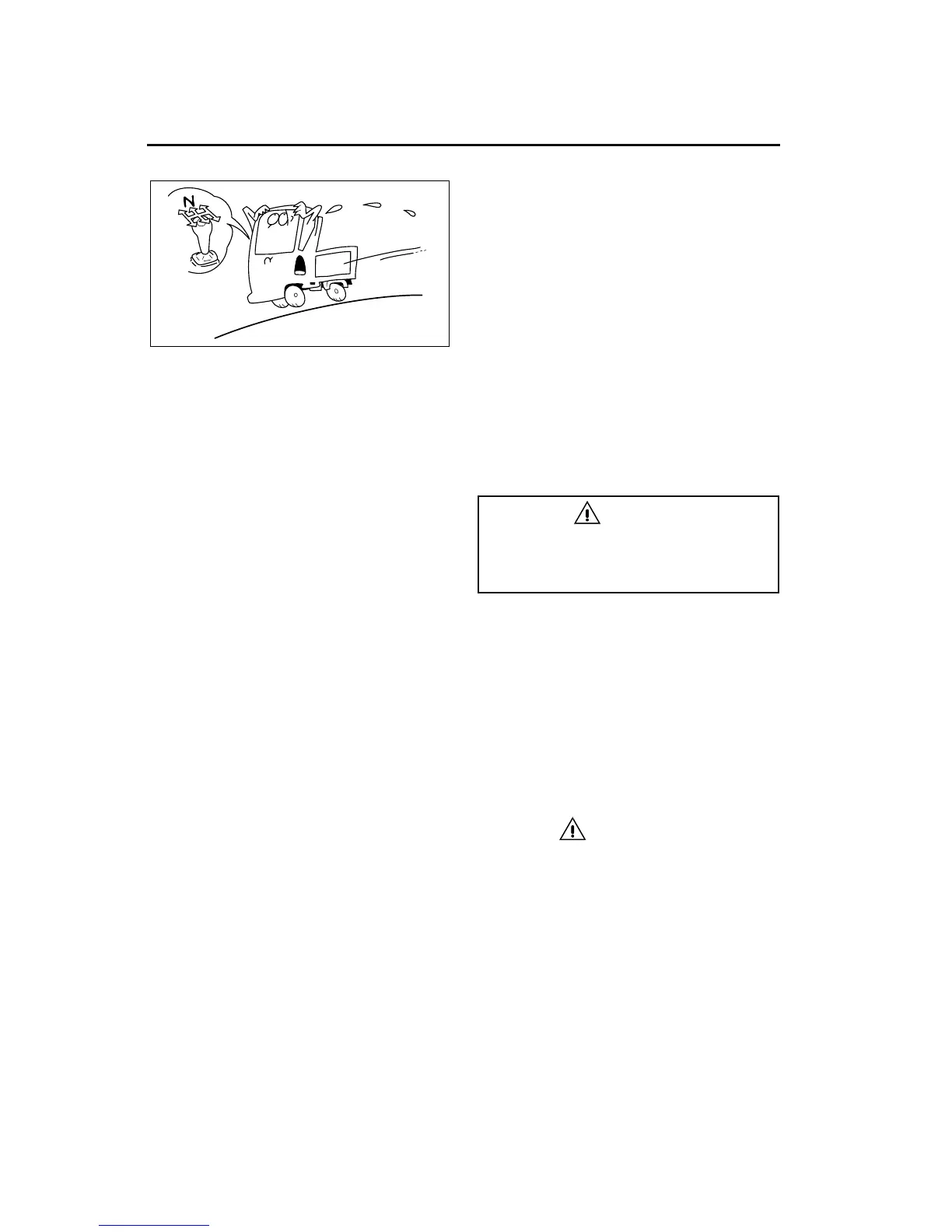
• Never coast downhill with the shift lever in neu-
tral <manual transmission vehicles> or the shift
selector in “N” (neutral) <automatic transmission
vehicles>. This eliminates the effect of both the
engine brake and the exhaust brake. This
causes the service brakes to overheat and the
brake linings to wear prematurely.
In a vehicle with automatic transmission, this
can also cause transmission damage.
• Do not overuse the service brakes. Overheated
brakes could cause vapor lock and fading, both
of which contribute to poor braking.
NOTE:
• “Vapor lock” is a condition in which the brake
system becomes so hot that the brake fluid
boils, forming bubbles that reduce hydraulic
pressure and result in poor braking.
• “Fading” is a condition in which the brake pads
overheat. This reduces friction significantly and
results in poor braking.
• Reduce engine speed before downshifting.
Do not downshift more than two gears at a time.
This could cause engine overspeed (tachometer
needle in the red zone).
As a rule, reduce engine speed to roughly 2,000
rpm before downshifting. Make sure the tachom-
eter needle does not enter the red zone.
In an automatic transmission vehicle, a safety
device prevents downshifts when the vehicle is
driving at high speed. To downshift in this situa-
tion, first depress the brake pedal and reduce
the vehicle speed.
CAUTION
“Engine overspeed” is used to describe a con-
dition where the engine speed (rpm) exceeds
the maximum safe limit. Persistent engine over-
speed can cause an engine breakdown.
WARNING
Except in an emergency, do not apply the
parking brake while the vehicle is moving
since the vehicle could spin and/or overturn,
causing an injury accident or loss of life.
Z11321


 To Next Page