22 OCH0006F08/13/2024
CEILAIR
®
CW & DX IOM
2.3 RIGGING
STRUCTURE RVALUE
Ceiling R38
Wall R21
Floor R19
Door R5
The vapor barrier is the single most important requirement for maintaining environmental control in the
conditioned space. The vapor barrier in the ceiling and walls can be polyethylene film. Concrete walls and
floors should be painted with a rubber- or plastic-based paint. Doors and windows should be properly sealed.
Install a door sweep to minimize leakage. Outside air adds to the cooling, heating, dehumidification, and
humidifying loads. Therefore, minimize outside air intake while maintaining the requirement of the Indoor Air
Quality (IAQ) standard. Lack of these steps can cause erratic operation, unstable room control, and excessive
maintenance costs. Inefficient insulation wastes money.
2.3 Rigging
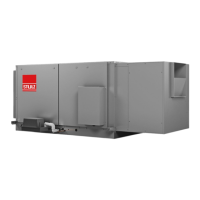
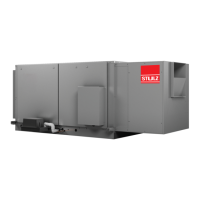
CeilAir systems are designed to be kept in a horizontal position. The unit is shipped on a skid to facilitate
moving prior to installation. A suitable lifting device should be used to lift the unit from the bottom. A weight
table is provided for reference on the installation drawing. The unit should always be stored indoors in a dry
location prior to installation.
CAUTION
When moving the unit, it must be kept horizontal and level to prevent damage.
2.4 Mounting
CeilAir systems are designed for ceiling mounting in a suspended ceiling grid, for spot coolers, or above the
suspended ceiling for ducted systems. See Figure 6. Typical Installation.
These units have rigid welded frames. The system is designed to be installed on a roof curb —which is
provided by others —and ducted into one space to be conditioned. Ensure the curb is sealed to prevent air
leakage. See the detail drawing provided with the unit for interface dimensions.
NOTE Mounting Tips
• Do not install the A/C system directly above electronic equipment that may hinder serviceability.
• Equipment must be level to operate properly.
CAUTION
These units are designed to condition only one room because the fans use composite impellers. If the
composite impellers burn, the dense toxic smoke and airborne fibers must be limited to a single room.
Table 2. Recommended Minimum Thermal Resistance



 To Next Page