•
Do not operate damaged gearmotors or reducers; otherwise, injury, re, or damage to the equipment
may result.
•
Sumitomo Machinery Corporation of America cannot assume any responsibility for damage or injury
resulting from an unauthorized modication by a customer, as it is outside the scope of the warranty.
•
Dispose of unit’s lubricant as general industrial waste.
•
When measuring the insulation resistance of explosion proof motors, conrm that there is no gas or
other vaporized explosive substance around the unit in order to prevent explosion or ignition.
•
Changing brake linings requires experience. Consult with the nearest authorized service station.
•
Brake torque will change with operation environment and conditions, the condition of the friction
surface, and other factors. In particular, brake torque may not be at the prescribed level for initial
operation, and after a long period of inactivity. In such a case turn the brake on and o under as light
load as possible to contact the brake’s friction surfaces.
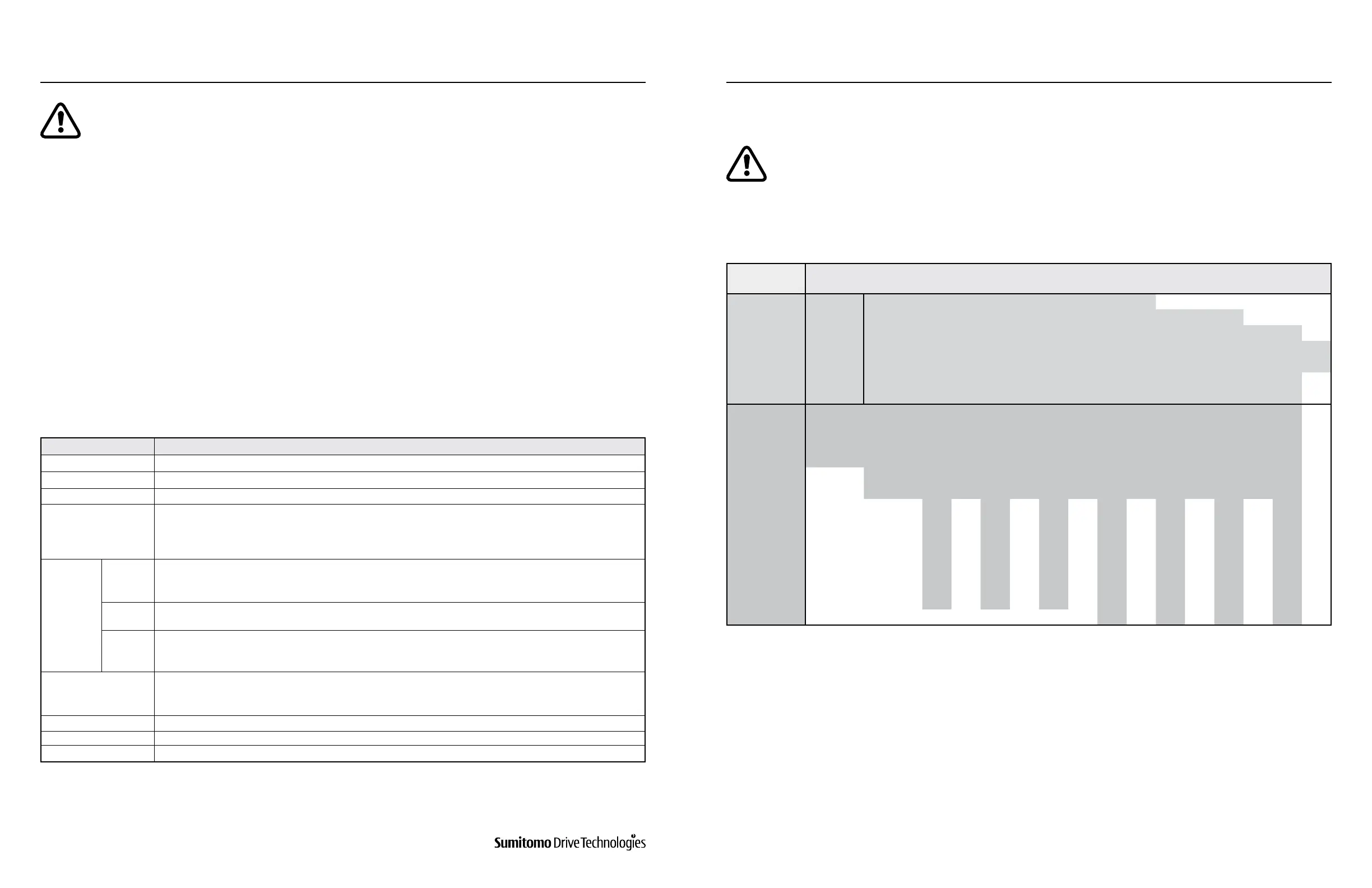
Table 8-1: Daily Inspection
Table 8-2: Lubrication for Horizontal Mount Single Reduction
Inspection Item Inspection Detail
Current value Is the current no greater than the rated value shown on the nameplate?
Noise Are there unusual noises, or are there extreme changes in the noises?
Vibration Is there abnormally large vibration? Are there extreme changes?
Surface Temperature
Is surface temperature unusually high? Has there been a sudden rise?
Temperature rises during operation will dier according to model and type. However, the dierence between
the gear unit surface temperature and the environment temperature should be approximately 60°C. In this case,
there is no particular problem if uctuation is slight.
Oil Level
(Oil
Lubricated
Machines)
At Rest
Is the oil level below the red line at the top of the oil gauge when the machine is at rest?
If when at rest the oil level is below the top red mark, ll up to the mark with lubricating oil. Do not add while
the machine is running.
While
Running
Is the oil level signicantly dierent than the level during stable operation?
The bottom red mark is an auxiliary mark serving as a guideline to check oil level while the machine is running.
Plunger
Pump/
Trochoid
Are the oil signal and ow gauge working properly?
If the oil signal and ow gauge are not working properly it is a sign of improper reducer lubrication, due to
factors including insucient oil, pump damage, and plugged pipes. Immediately stop the machine and inspect.
Lubricant
Contamination
Is the lubricating oil contaminated?
To check for oil contamination, in addition to extracting oil while the machine it stopped, it is also possible to
check using the oil gauge. If the oil gauge is contaminated, promptly change it.
Oil, Grease Leaks Are oil or grease leaking from the gear unit? Are the oil seal sliding surfaces corroded?
Mounting Bolts Are the mounting bolts loose?
Chain, V-Belt Are the chain or V-belt loose?
Please look for the relevant items and make certain to do maintenance. Neglecting maintenance is a
source of trouble.
www.SumitomoDrive.com
Cyclo® 6000 Operating and Maintenance Manual
Cyclo® 6000 Cyclo® 6000
Cyclo® 6000 Operating and Maintenance Manual
36 37
8. DAILY INSPECTION AND MAINTENANCE
Make certain to carry out daily inspections in accordance with Table 8-1. Neglecting inspections is a source of trouble.
Check Tables 8-2 to 8-5 for the lubrication method employed by the gear unit of the model used.
If any abnormality is discovered during the daily inspection, take measures in accordance with “9. Troubleshooting”
(Pages 68 to 70). If these actions do not remedy the issue, immediately contact the nearest authorized service station.
8.1 Daily Inspection
8.2 Lubrication
Frame Size
Reduction Ratio
3 5 6 8 11 13 15 17 21 25 29 35 43 51 59 71 87
119
6060, 6065
Grease
6070, 6075 59
6080, 6085 87
6090, 6095 Maintenance Free Grease
6100, 6105, 610H
6110, 6115
6120, 6125, 612H
6130, 6135
6140, 6145, 614H
6160, 6165, 616H
6170, 6175 Oil
6180, 6185
6190, 6195
6205
6215
6225
6235
6245
6255
6265
6275
8. DAILY INSPECTION AND MAINTENANCE



 To Next Page