1-26 Publication: 0028607
SAFETY
1
HYDROCARBON WASTE RECOVERY
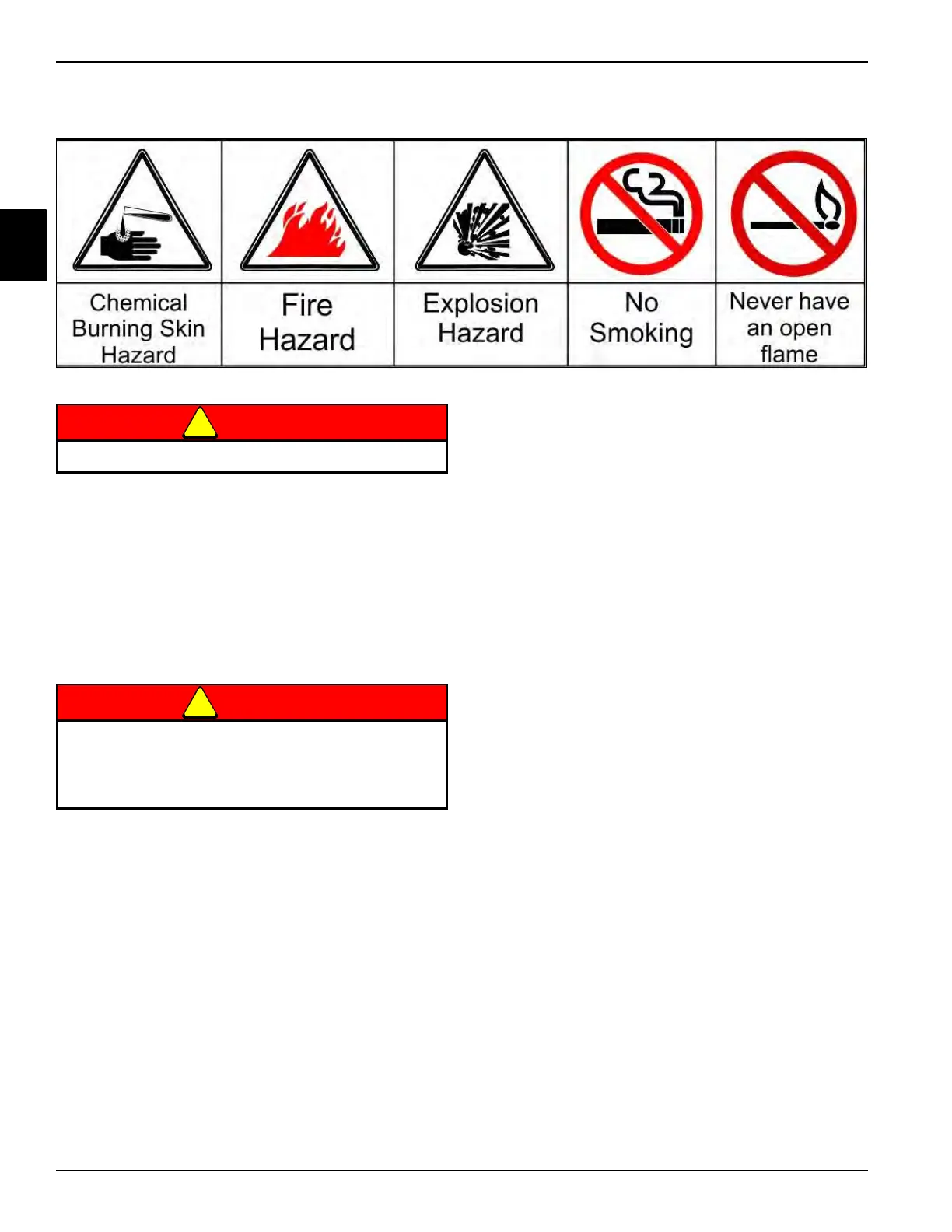
Figure 1-27
Never use a rotary lobe blower to vacuum materials with
flash points below 150°F. However, hydrocarbon
materials with flash points greater than 150°F may be
picked up with a rotary lobe blower if the following four
concerns are addressed:
• Controlling the lower explosive level (LEL)
• High temperature prevention
• Static charge dissipation
• Spark prevention
A rotary lobe blower may be used to pick up materials
with flash points greater than 300°F without addressing
the four concerns.
Refer to API Standard 2219 for more information on safe
operation of vacuum trucks in petroleum service.
Controlling Lower Explosive
Level (LEL)
Super Products recommends that a monitor for
hazardous hydrocarbon concentrations be installed in the
exhaust stream of the vacuum pump to continuously
monitor for lower explosive level (LEL). The monitor must
be properly calibrated based on the product being picked
up.
For details on how the monitor operates, it is suggested
you contact a reputable monitor manufacturer such as
Industrial Scientific Corporation in Oakdale, PA at
1-800-338-3287.
If the LEL reading approaches 50%, it is recommended
that the operator at the end of the work hose lift the hose
out of the material being conveyed and allow only air to
enter the vacuum hose. As an alternative, a bypass
switch could be installed to open the two valves
discussed in “High Temperature Prevention” on page
1-27.
Do not vacuum flammable or explosive materials.
It is not recommended that materials with a flash
point below 150°F be picked up under any
operating conditions. The potential for an
explosion is too great.


 To Next Page