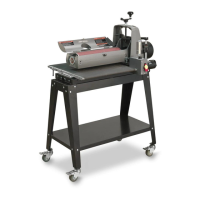
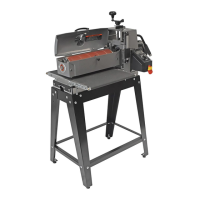
OPERATING YOUR SUPERBRUSH 11
Many types of brush heads may be rewound with
new bristles or re-equipped with new brush material.
Please contact SuperMax Tools if you have questions
about a new or re-wrapped brush head.
Some types of brush heads, some fladder brushes,
for example, will allow changing of the brush
material by the operator, thus eliminating the need
to send the brush head out for re-wrapping. Please
call SuperMax Tools if you have any questions
about re-wrapping a brush.
When using a wire brush for “distressing” wood,
slowing brush RPM, using light contact and a
moderate feed rate generally will give the best finish
and longest brush life.
When using a wire brush on metal, it is important
to use a light contact of the bristle tips.
Wire brushes frequently flipped end for end, to
keep the wire from bending in one direction, will
extend brush life. Caution, if you choose not to
flip the brush frequently, it is better not to flip the
brush at all.
Nylon Brushes. “Dress” tips of bristle brush peri-
odically to maintain uniform brush wear and to
expose new grit on the ends of the fiber.
Dressing Instructions:
Staple a wide sheet of 60 grit sandpaper to a 1/2˝
thick flat wood surface. Strips of narrow sandpaper
can also be used. Raise the brush so the tips of the
bristles contact the sandpaper by 1/32˝. Set the
conveyor speed to approximately 50% feed rate.
Pass the abrasive loaded board through the
machine until the brush fibers are sharp and even.
DEPTH GAUGE OPERATION
The depth gauge (see Fig. 11) measures the distance
between the conveyor table and the bottom of the
sanding brush. The sanding brush must be parallel
to the conveyor bed surface. To calibrate the depth
gauge, loosen the locking knob of the lower depth
gauge casting so it rests on top of the table support
casting. Raise the conveyor table until it touches
the sanding brush. Then loosen the locking knob
of the upper depth gauge casting and position the
“0” mark of the scale even with the top of the
lower depth gauge casting. Lock the upper depth
gauge casting in position.
Once calibrated, the locking knob of the lower
depth gauge casting can be loosened, allowing the
lower depth gauge casting to ride on top of the
table support casting. The depth can then be read
where the scale enters the lower depth gauge casting.
The depth gauge can also be used as a stop gauge
as follows: Position the lower depth gauge casting
along the scale to a desired finish thickness. Then
lock the lower depth gauge casting with the lock-
ing knob to prevent the conveyor table from being
raised above that point
MONTHLY MAINTENANCE
For best results, perform the following recommended
maintenance procedures on a monthly basis:
• Lubricate conveyor bushings and check for wear.
• Lubricate all moving parts, such as threaded
rods, washers, and column tubes.
• Clean dust from the conveyor belt.
• Blow dust from the motors.
• Check all set screws for tightness on parts such as
brush support castings, bearings, conveyor cou-
pler, castings, pulleys, and miter gears.
• Clean brush, if applicable.


 To Next Page