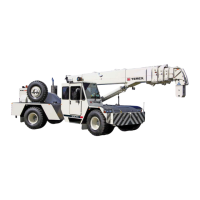
MOVING THE CRANE TO A JOB SITE
The procedure for moving a crane is as follows:
1. Start the engine, following the procedure given in the topic “Starting the Engine”.
2. Allow air pressure build-up.
3. Apply the swing brake.
4. Apply the swing lock.
5. Apply the Service Brake.
6. Release the Parking Brake.
7. Select the desired transmission range.
Good judgement in the selection of gear range and route of travel is essential when
operating off the road.
Though designed primarily for use in off-road conditions, there may be instances when
highway travel is necessary. In such instances, the crane is subject to the same regulations
which govern the operation of other heavy equipment on public roads. Adequate lighting,
flares, flags and safety equipment should be on the cranes at all times.
When operating on hard surfaces, use high range F4 thru F6 two-wheel drive
only.Failure to do so may result in severe drive line “wind-up” and component
failure.
The operator may start from rest in either forward or reverse in F4 or F2.
this is supposed to be an alert
In addition to conditions of terrain, gear selection while traveling is also determined by
transmission temperature. Normal operating temperature is 160 to 200 deg. F. If the
transmission temperature rises above 250 deg. F. (121.1 deg. C.) while traveling, the crane
must be stopped and allowed to cool. Shift to neutral and run the engine at 1000-1200
rpm. The temperature should drop rapidly to the engine coolant temperature. If the
temperature does not drop, trouble is indicated, and should be determined before moving
again. Overheating generally occurs due to working in too high a gear ratio. DO NOT SHUT
OFF THE ENGINE WHEN THE TRANSMISSION IS OVERHEATING.
NEVER SHIFT BETWEEN FORWARD AND REVERSE WHILE THE CRANE IS IN
MOTION.
Full power shifts under load may be made with- out endangering the transmission or drive
components. However, downshifts should not be made when the vehicle speed exceeds
the maximum speed of the next lower range. Downshifting at excessive speeds will
overspeed the drive train components with possible resultant damage to the drive shafts.
Do not travel for extended periods at wide open throttle.
RT500
Operating Instructions
136 REVISED:


 To Next Page