48
TK 56430-18-IP-EN
Allowing for Movement
Refrigerant hoses must be installed to allow for changes in length due to component motion, vibration, pressures, and
temperatures. Failure to allow for movement will cause hoses to leak and fail.
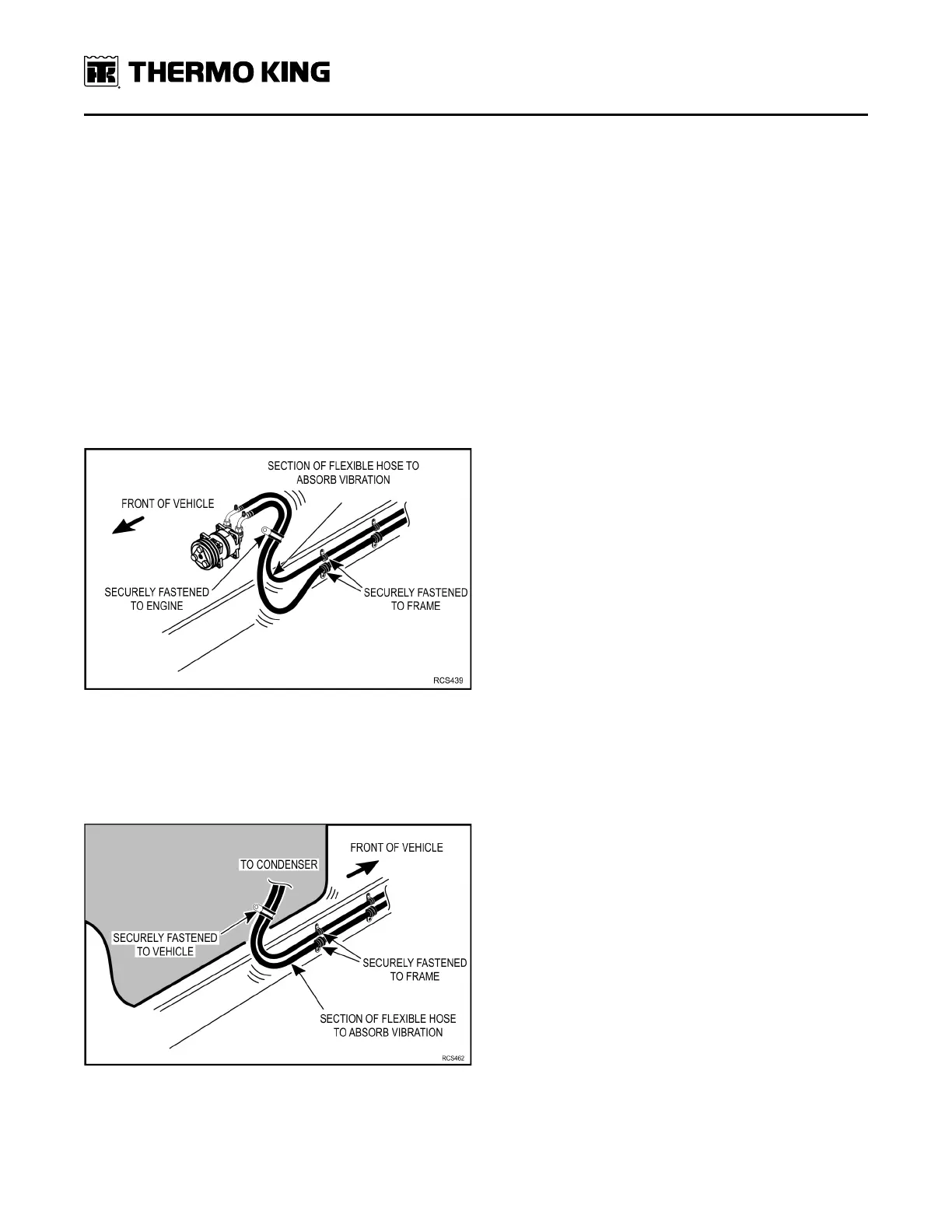
Two examples are shown below where hoses need to allow for movement.
EExxaammppllee 11:: The transition point from the stationary frame to a moving engine must include a section of flexible hose to
absorb vibration.
• Hoses attached to the compressor must be allowed to move with normal engine operation.
• Under high torque loads, the vehicle’s engine can rotate substantially. You must provide enough hose slack so this
engine movement does not apply force to the compressor fittings.
• Additionally, hoses spanning the gap between the vehicle’s engine, the unit’s compressor, and the vehicle’s frame,
must be properly secured to both the frame and the engine block. This limits normal engine vibrations and torque
from being transferred to the compressor fittings.
IImmppoorrttaanntt:: It is critical that P-Trap is installed in the suction line before the roadside compressor. Refer to (“Suction
Line Routing and P-Trap Formation,” p. 56).
Figure 42. Example 1
EExxaammppllee 22:: Similar situation for a condenser unit:
• Hoses attached to the cargo box or van body must have a section of flexible hose to absorb vibrations and allowed
to move and flex with normal vehicle operation.
• Hoses must be securely fastened to the vehicle and the frame.
Figure 43. Example 2
SSeeccttiioonn 66 -- RReeffrriiggeerraanntt HHoossee aanndd FFiittttiinnggss SSttaannddaarrddss







 To Next Page