ELECTRICAL SYSTEM
11
CUSTOMER CARE | 877.855.2867
140
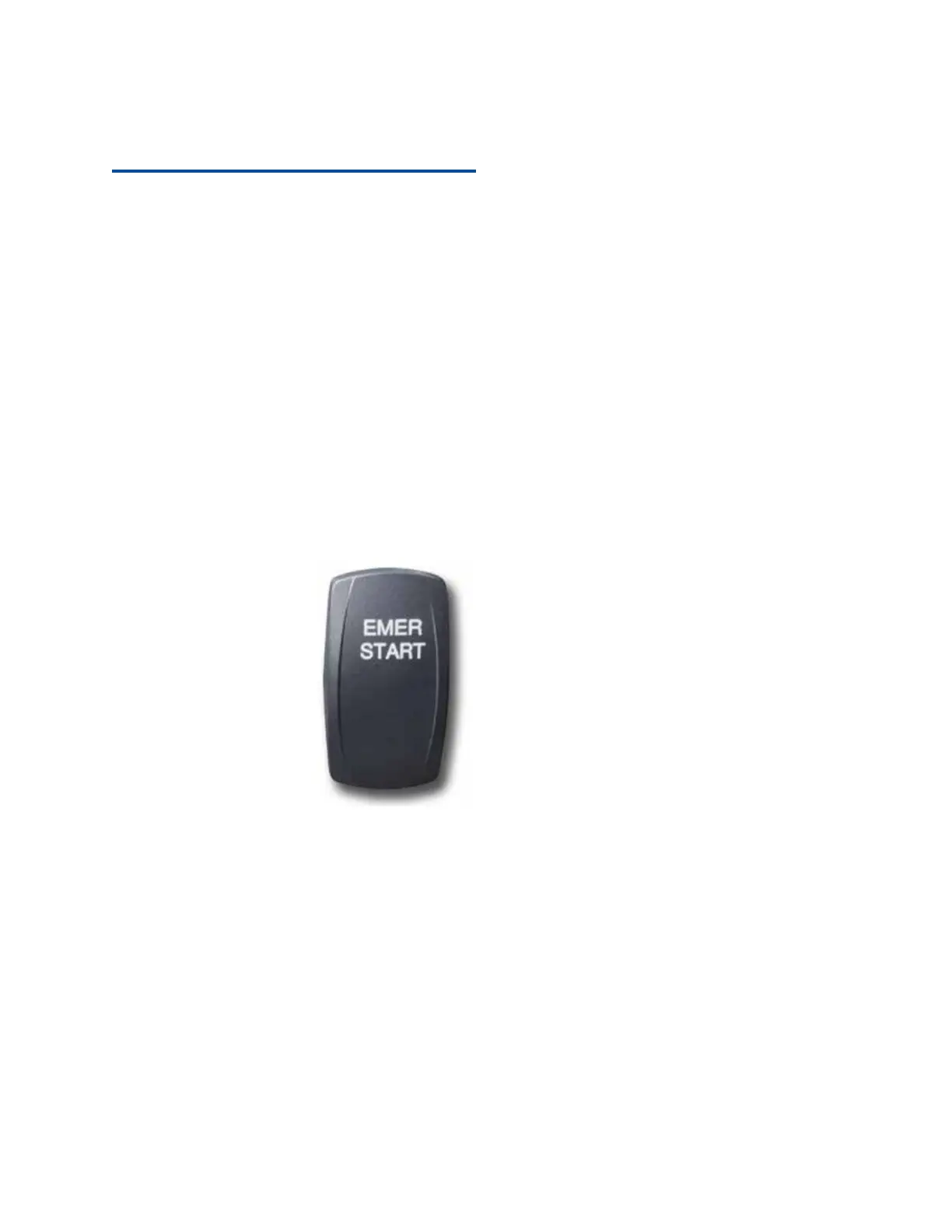
Typical emergency start switch
Turn off all 12-volt DC devices before using the
emergency start feature. This will help ensure that all
available energy stored in the auxiliary battery(ies) can
be used for vehicle starting.
The Emergency Start feature may not be available
on Class C motorhomes with Lithium-Ion auxiliary
battery(ies). See Lithium Battery System Guide.
NOTICE
TMC motorhomes are may be equipped with an Emergency
(auxiliary or AUX) Start. Located in the vehicle’s cockpit, near
the drivers seating area, this feature connects the auxiliary
battery(ies) to the vehicle’s starting circuit. Emergency Start
is used in situations when the chassis battery is too depleted to
start the vehicle on its own. Electrically connecting the auxiliary
battery(ies) to the engine starting circuit oen provides the
needed energy to start the motorhome’s engine. When the
Emergency Start Switch is released, the auxiliary battery(ies)
is disconnected from the engine starting circuit.
To operate:
1. Ensure the master battery
switch is ON.
2. Depress the ‘EMER
START’ switch, located
on the front driver’s dash
and HOLD.
3. Use the ignition switch
(key or start button) to
start chassis engine.
4. Release the ‘EMER
START’ switch after the
engine has started.
NOTES:
•
Select TMC Class A and C motorhomes feature the
Emergency Start feature integrated into the dash
radio display panel (see Electrical Systems Monitor-
ing section).
•
When using the Emergency Start feature, do not
hold the ignition key in the start position for more
than 30 seconds.
•
If starting cannot be accomplished, operating the
generator for a few minutes may give the batteries
the charge needed to start the vehicle.
Emergency (Auxiliary) Start
Emergency generator starting:
e Emergency Start feature can also be used to deliver extra
starting power to the generator. is is accomplished by
electrically tying the chassis battery to the auxiliary battery
via the Emergency Start Solenoid (this solenoid is actuated
by energy from the auxiliary battery and controlled by the
Emergency Start Switch). is feature is useful in circum-
stances when the auxiliary (house) battery is too depleted
to start the generator.
1. Ensure the Master Battery Switch is ON.
2. Press and hold the Emergency Start Switch.
3. While holding the Emergency Start Switch in the ON posi-
tion, DEPRESS
the Generator Start Switch (see generator
starting procedure). Since these two switches are not
physically near each other, you may need the assistance
of another person to operate one of the switches.
4. When the generator has started, RELEASE the Generator
Start Switch and the Emergency Start Switch.
5. Keep the Main Battery Switch ON while the generator
is operating. is will allow power from the generator
to charge the auxiliary (house) and chassis batteries via
the converter (or in some installations, the inverter).
If the auxiliary battery is completely dead, it will not have
enough reserve power to engage the emergency start solenoid,
therefore the generator starting method described above will
not be successful.
An alternative method of emergency generator starting that
will work for all TMC motorhomes except Class C's with
Lithium-Ion auxiliary batteries (see page 144), is:
1. Start the vehicle's engine and wait for the emergency
start solenoid to engage on its own. is may take a
few moments.
Running the vehicle's engine will allow energy from
the vehicle's alternator to activate the emergency start
solenoid, in turn, supplying charging energy to the
auxiliary battery.
2. Allow the vehicle's engine to run for several minutes.
3. With the vehicle's engine still running and when the
auxiliary battery has recovered an adequate charge,
attempt to start the generator in the normal manner.
4. Once the generator starts, turn OFF the vehicle's engine.
As long as the generator is running, charging energy to
the auxiliary battery will be supplied from the generator
via the converter.



 To Next Page