ELECTRICAL SYSTEM
11
CUSTOMER CARE | 877.855.2867
164
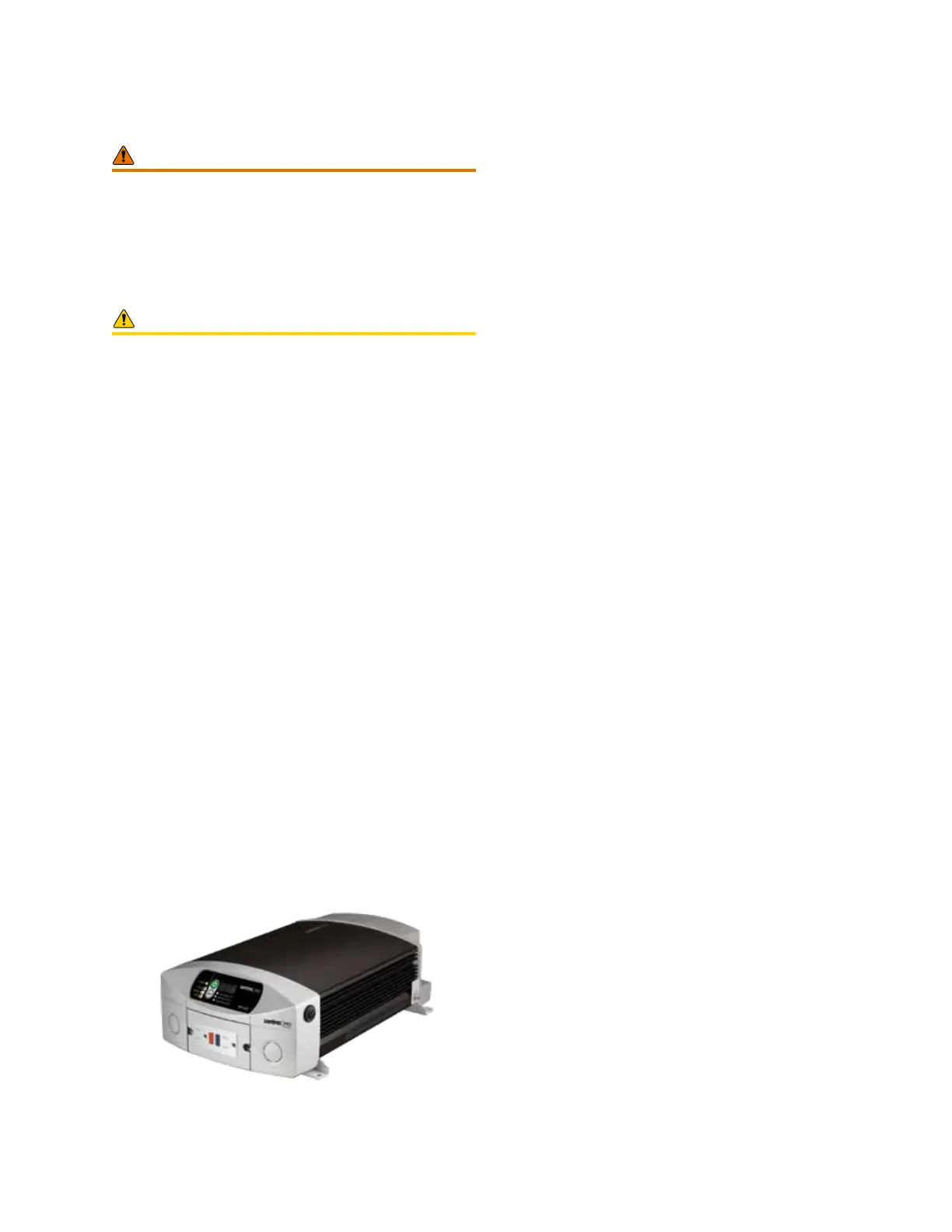
Typical inverter: model, features, and installation location varies,
depending on motorhome model and floor plan.
terms, the inverted-powered outlets are those that feed power
to the main TV, household-type refrigerator (if installed),
and a few essential AC power outlets.
All inverters have a wattage rating that will indicate the
maximum load (or electrical power) the inverter can supply.
For example, an 1,800 watt inverter will be able to provide
approximately 15-20 amps of current (amperage). Sometimes,
the wattage capacity is stated in kilowatts (kW). For example,
1,800 watts becomes 1.8 kW. Depending on the model and
oor plan, TMC typically installs inverters with power ratings
of 1,000 watts, 1,800 watts, or 2,000 watts.
Since the inverter is drawing power from the auxiliary
battery(ies), the condition and storage capacity of the bat-
teries determines how long the inverter can supply power
to the motorhome's 120-volt AC devices. Keep in mind
that while traveling, a charging voltage to the batteries from
the vehicle’s alternator is available, as long as the master
battery switch is ON. Maintaining a charging voltage to the
auxiliary battery(ies) will prolong the energy available from
the battery(ies) to the inverter.
Battery voltage is also important for proper inverter opera-
tion. Most inverters have an automatic shut-o feature that
turns the inverter o in the event that the incoming voltage
of the supply battery(ies) drops out of range; usually below
10 volts DC or above 16 volts DC.
For details regarding the inverter supplied to your motor-
home, its features and functions, please refer to the
manufacturer’s operational guide included with your or
Motor Coach Owner’s Packet, available through the TMC
Owners Resource service, or directly from the inverter
manufacturer's website.
Inspection and Maintenance
Most inverter installations include a separate circuit breaker
installed in the battery compartment, near the auxiliary
battery. is circuit breaker protects the inverter from over-
loads (attempting to draw more power from the inverter
than it is designed to supply). If the inverter is not working,
check to determine if this circuit breaker is ‘tripped' (device
with a blue reset button). If so, re-set it and reduce power
consumption through the inverter.
Also check the fuse located on the inverter. Inverters are
typically installed behind a panel or bed pedestal near the
Power Load Center (fuse and circuit breaker panel). ere
are no consumer serviceable parts inside the inverter case
and the manufacturer’s warranty will be void if the case has
been opened. e inverter's cooling ns and the cooling fan
must be kept clear of any obstructions. If you have further
concerns, contact your dealer.
Select TMC motorhomes are equipped with an inverter.
An inverter takes 12-volts DC power from the auxiliary
(house) battery(ies) and transforms it into 120-volts
AC power. It is mainly used to power a few select electrical
circuits and devices when an external source of 120-volts
AC power is not available, or when it is not appropriate to
operate the on-board generator. Inverters are also installed
in motorhomes that have a household-type refrigerator
(compressor, instead of an evaporator type). ese appliances
usually require 120-volts AC in order to operate, therefore
the inverter allows the refrigerator to be used whenever shore
power or generator power is not available.
Some inverters include a built-in automatic transfer switch,
which will connect the inverter to the electrical system when
needed and disconnect when either shore power or generated
power is detected. In addition, some inverter models also
perform the function of a converter (supplying 12-volt DC
power from a 120-volt AC source). Inverter/Converter
models are mainly installed on Class A diesel motorhomes.
Although wiring varies from model to model, in general
Some appliances and equipment may not operate
correctly from the modied sine wave of an inverter, and
other appliances may actually be damaged if operated
on inverted power.
Check with the device manufacturer regarding the
suitability of use with an inverter.
CAUTION
Review all manufacturer's information and observe all
manufacturer's safety warnings and cautions before
using the inverter installed in your motorhome.
The factory-installed inverter is not intended for use with
medical device(s).
WARNING
Inverter



 To Next Page